Brasilia Metro, Brazil


|
Brasilia Metro is a two-line rail system that links Brazil's capital Brasília to the satellite cities of the Federal District. Operated by Metro-DF, Brasilia Metro has been offering regular services since September 2001. In March 2001, Brasilia Metro started operating a 32km line from Central station to Terminal Samambaia/Praça do Relógio with 11 stations. Commercial services of the metro started during September 2001. 
In February 2002, Samambaia Sul and Arniqueiras stations were opened to traffic while Concessionárias station was opened in May 2004. Praça do Relógio-Ceilândia Sul was provided with a shuttle service and service from Central station during 2006 and 2007. The 108 Sul station was opened in April 2008 and 112 Sul station in May 2009. South metro station 102-DF was inaugurated in June 2009. The project Brasilia Metro operates two lines called linha verde (Green line) and linha laranja (Orange line). The lines run parallel until Aguas Claras, the station where they share tracks through Asa Sul and Guará. "The subway has resulted in reduced travel times, noise, visual pollution and carbon emissions."
The 33km linha verde runs west from Central station through 24 stations to Taguatinga and Ceilandia. The 42km linha laranja extends from Central to Samambaia in south with 19 stations. In June 2009, a contract was signed between the Government of the Federal District (Governo do Distrito Federal [GDF]) and Banco Nacional de Desenvolvimento Economico e Social (BNDES) to lend $260.3m to the government for funding the expansion and modernisation of the metro's fleet. GDF has invested about $7.3m in the subway to install 22 escalators at various stations. Infrastructure The system, with 23 stations, starts at Brasilia's Bus Central Station and passes through a subway in Brasilia and Praça do Relógio, centre of Taguatinga. The subway has resulted in reduced travel times, noise, visual pollution and carbon emissions. The metro mainly serves the largest satellite cities: Guará, Águas Claras, Samambaia, Taguatinga and Ceilândia. Residents of these cities mostly depend on public transport. The service with 20 four-car trains can carry 1,350 passengers. The commercial speed of the metro is 45km/h and its track gauge is 1,600mm. Rolling stock Brasilia Metro has 20 trains of four cars each and 23 stations. Alstom's contract will add 12 train sets to the fleet. The trains manufactured at Alstom's Lapa site in São Paulo are scheduled to be delivered in 2010. The 48 Metropolis cars that will be supplied to the metro are made of stainless steel and will be low-floored to ensure easy boarding of passengers. The trains will also be fitted with illuminated information boards. In July 2009, operator METRO-DF awarded a €110m contract to Alstom for supplying 12 train sets each composed of four Metropolis cars. The contract also includes the installation of an automatic train operation (ATO) system. "Additions to the fleet are expected to increase the capacity of the metro to 300,000 passengers a day."
The ATO equipment, which will enable the metro to reduce headways from 4.5 to 3 minutes, will be fitted to the existing 20 train sets, in all the stations and along the entire length of the line. The ATO system is expected to ease overcrowding. The future The GDF and BENDES development programme, which will receive $325m in total, focuses on acquiring 12 four-car trains and modernising the signalling system and the existing fleet. Additions to the fleet are expected to increase the capacity of the metro to 300,000 passengers a day. The expansion plan under the package includes the extension of the 42km line 1 to 49.2km, 34 stations and 32 trains. Construction of a $140m station near the North Wing Regional Hospital is underway. In addition, a proposal is being considered to construct two more stations in Samambaia by investing $150m. |
  Expand Image Expand ImageThe Brasilia metro system is made up of two lines, Green and Orange, which run alongside each other until breaking apart at Aguas Claras. |
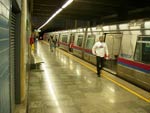 Expand Image Expand ImageOperator Metro-DF is planning further expansion of the system, with a new rolling stock contract agreed with Alstom and plans for extensions and modernisation. | |
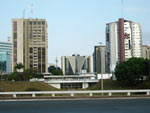 Expand Image Expand ImageResidents of Brasilia's 'satellite cities' depend on public transport, so smooth running and upgrades of the metro system are essential. |