Bilbao Metro, Spain


|
A rapid transit railway underground network, the Bilbao Metro is owned and operated by Basque-based Biscay Transport Consortium (CTB). CTB uses a meter-gauge network for the Bilbao Metro. The network is completely underground, with 38 stations and nine substations currently in service. The Bilbao Metro project was originally proposed in the early 1920s. The financial crisis and the Spanish Civil War, however, led to the termination of the project. In 1976 Bilbao City Council and the Commerce Bureau established the CTB for developing the metro. In 1987 the Basque Government approved a construction plan for the project, which was financed by the government. 
About 86 million passengers used the Bilbao Metro in 2007. The ridership drastically increased during 1998 to 2002 as the network was expanded. The ridership is expected to reach 100 million passengers a year after completion of the entire network in 2011. Routes The Bilbao Metro consists of two lines, Line 1 and Line 2. Line 1 passes along Etxebarri to Plentzia station via Bolueta, Basarrate, Santutxu, Casco Viejo, Abando, Moyua, Indautxu, San Mames, Deusto, Sarriko, San Inazio, Lutxana, Astrabudva, Leioa, Lamiako, Areeta, Gobela, Neguri, Aiboa, Algorta, Bidezabal, Ibarbengoa, Berango, Larrabasterra, Sopelana, Urduliz and Plentzia stations. "The ridership is expected to reach 100 million passengers a year after completion."
Line 2 connects Etxebarri with Santurtzi, passing through Bolueta, Basarrate, Santutxu, Casco Viejo, Abando, Moyua, Indautxu, San Mames, Deusto, Sarriko, San Inazio, Gurutzeta / Cruces, Ansio, Barakaldo, Bagatza, Urbinaga, Sestao, Abatxolo, Portugalete, Penota and Santurtzi stations. Line 2 passes along a route similar to that of Line 1 until San Inazio, where it deviates towards the south, reaching Santurtzi station. The Bilbao Metro is broadly categorised into three zones: Zone A, Zone B and Zone C. Zone A connects stations from Bolueta to San Inazio, while Zone B links Lutxana to Berango in Line 1 and Lutxana to Santurtzi in Line 2. Upon completion the two lines together will span about 40.6km and have 41 stations. Line 1 will have 30 stations and Line 2 will have 11 stations. Project The main aim of building the metro was to ease congestion in Bilbao. The initial contract for the underground metro design was awarded to Sir Norman Foster and Partners in 1988. The same year the first underground station in Line 1 opened to the public. The first stage of Line 1, encompassing 23 stations from Casco Viejo and Plentzia, was inaugurated in November 1995. Four more stations, Santutxu, Basarrate, Bolueta and Gobela, were added in July 1997. The construction of the main Moyua Square station, which began in 1989, was completed in 1997. With the inauguration of Etxebarri station along Line 1 in January 2005, the total number of stations on the line reached 28. The remaining two stations in Line 1, Ariz and Basauri, will be inaugurated in 2010. Five new stations in Line 2, Gurutzeta-Cruces, Ansio, Barakaldo, Bagatza and Urbinaga, opened in April 2002. Sesato along Line 2 was inaugurated along with Etxebarri station in January 2005. The line was further extended to Portugalete, adding two more stations, Abatxolo and Portugulete, in January 2007. Another two stations, Penota and Santurtzi, were added to Line 2 in July 2009. Kabiezes station, which is under construction along Line 2, will open in 2011. Infrastructure "Stations are equipped with public address systems, ticket machines and warning buzzers on trains."
All Bilbao Metro stations include glass structures. Large caverns were dug for the stations, creating open spaces. Steel and concrete mezzanine structures were built over the tracks, while lifts and escalators provide access to trains. Stations are also equipped with public address systems, ticket machines and warning buzzers and lights on trains. They also feature signs with contrasting colours to make reading them easier and Braille signs in lifts. Rolling stock Bilbao Metro uses three types of cars: UT-500, UT-600 and UT-550, all of which are manufactured by CAF. Currently 24 UT-500 cars and 13 UT-550 cars are operating in the Bilbao Metro. The cars are maintained and parked in Sopelana and Ariz stations. The UT-500 and UT-550 cars are equipped with state-of-the-art systems. Motor carriages in the cars improve power, acceleration and braking. Welded stainless steel was used in the development of the railcars. Although both types of railcar appear similar, the UT-550 series has more features than the UT-500. They include a new air conditioning systems, advanced soundproofing and handgrips. The UT-550 also features an information display system (IDS). The IDS is directly connected to the central control desk. Elastic wheels in all bogies of the railcars reduce noise. The railcars also feature an automated wheel lubrication mechanism, allowing them to run smoothly over various sections of the track. The railcars can travel at 80kmph. An automatic train protection (ATP) system and automatic train operation (ATO) system were introduced in 1998. Signalling and communication In June 2008 Bilbao's Consorcio de Transportes de Bizkaia awarded a contract to technology provider Thales to design, implement and maintain its supervisory control and data acquisition (SCADA) solution. Bilbao Metro's four remote command centres, train traffic management, electro-mechanical control facilities at stations, energy usage, passenger communication and security are managed by Thales. The future A third line (Line 3), which connects Rekalde to Moyua in a north-south layout, has also been proposed. Another extension of the railway line east to Galdakao is in the proposal stage. A new railway link from the airport towards the east of Bilbao is also planned but will not be part of Line 3. |
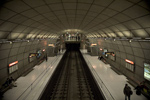  Expand Image Expand ImageThe metro is completely underground, with 38 stations and nine substations currently in service. |
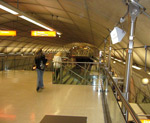 Expand Image Expand ImageAbout 86 million passengers used the Bilbao Metro in 2007. | |
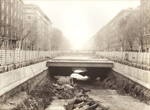 Expand Image Expand ImageThe ridership drastically increased during 1998 to 2002 as the network was expanded. |