Athens Trams, Greece


|
Athens’ tram system had closed by 1960 in the belief that the private car, taxis and buses could cater for the expanding city’s transportation needs. The Greek capital soon became synonymous with traffic congestion and air pollution towards the end of the 20th century. In September 1997, Athens was awarded the 2004 Summer Olympics, providing a new and pressing stimulus to address public transport in a metropolitan area with a population around 3.5 million. 
THE PROJECTAthens Tram was one of three urban transport projects specially constructed in relation to the Olympics, the others being the suburban railway and extension of the already enlarged Metro to the new Eleftherios Venizelos International Airport. The project is 50% funded by the European Fund of Regional Development of the 3rd Community Support Framework, the remainder being from national funds. "Athens was awarded the 2004 Summer Olympics, providing a new and pressing stimulus to address public transport."
Overall authority for public transport is Athens Urban Transport Organisation. Operating company Tram SA was founded in March 2001 as a subsidiary company of government-owned Attiko Metro SA. Initially targeted for 100,000 passenger journeys per day, there were shortfalls reported of around half of that number in the first year, partly attributed to retaining bus services that duplicated tram routes. It is anticipated that numbers will rise substantially with extension to Piraeus, an urban centre in its own right and generator of passenger traffic as the focal point of Greece’s extensive ferry operations. ROLLING STOCK The modular Pininfarina-styled Sirio fleet was supplied by Ansaldobreda of Italy. A continuous low floor, 350mm from the rail top to floor level, provides easy access from low platforms. The double-ended air-conditioned five-unit sets are made up of two two-car halves around a central short section accommodating the pantograph. As with platform signage, on-board announcements are in Greek and English. In preparation for the system opening a few weeks prior to the Olympics, intensive driver training was partly carried out in Germany. Maintenance is at the depot built on part of the former Athens Ellinikon Airport site on the coastal stretch, with some Olympic Airways structures adapted for tram use. As with works for the Athens underground rail lines, excavations revealed artefacts that attracted archaeological attention. INFRASTRUCTURE Construction work for the €340m project began in March 2002, with the official start of services in July 2004. Linking several of the Olympic venues (not including the main site), the 26km (16 mile) route follows the Faliro-Voula coastal strip with a link from near the Edem stop to Syntagma Square in the city centre, adjacent to the Greek Parliament and main shopping area. "The policy is that new routes will feature more interchanges with Athens’ other urban public transport modes."
A €150m contract for infrastructure, related electro-mechanical work and maintenance for the first three years was awarded to Italian-Greek Consortium Terna/Impregilo. Atkins Rail provided detailed design for the infrastructure, railway systems and related services such as workshop design and procurement of maintenance equipment. Hamburg-Consult was subcontracted for aspects of design and engineering during planning and commissioning. With real time indicators and low platforms at stations, all above-ground, the standard gauge tracks feature grass surrounds and tree plantings in many locations. Ticketing for different transport modes in the city is available, with trams intersecting with Athens’ extensive bus network and at three points with Metro lines. The network operates 05.00–01.00, with 24-hour operation Friday–Sunday. THE FUTURE The 0.7km extension from Kolimvitirio to Voula at the system’s southern end was given an autumn 2007 opening date. Scheduled for operation by the end of 2008, the final part of Stage 1 is over hilly, densely developed terrain for the 2.5km from Stadio Eirinis and Filias (Peace and Friendship Stadium) to central Piraeus, which is also linked to Athens city centre by Attiko Metro. Phase Two, designated for 2008–2020, includes expansion from the current city centre presence at Syntagma Square and for the eastern suburbs. The policy is that new routes will feature more interchanges with Athens’ other urban public transport modes. |
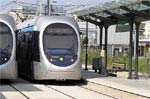  Expand Image Expand ImageCurrent northern limit at Stadio Eirinis and Filias. A 2.5km extension will reach central Piraeus. |
 Expand Image Expand ImageThe line reaches inland to Athens city centre from the coastal strip near Mouson. | |
 Expand Image Expand ImageOpposite the Greek Parliament, the city centre terminus at Syntagma Square. | |
 Expand Image Expand ImageA high capacity underpass to meet peak demands at Stadio Eirinis and Filias. | |
 Expand Image Expand ImageTramway features in residential areas are softened by trees and grass strips. | |
 Expand Image Expand ImageContinuous low-floor Sirio trams offer ease of movement. |