Argentine High-Speed Railway, Argentina


|
Passenger rail travel in Argentina is a limited commodity. Privatisation resulted in the removal of many the country's passenger trains, with only a few long and slow journeys still possible on the existing network. The principal railway network in Argentina is now undergoing major refurbishment. However, with existing passenger services also running at infrequent intervals using old rolling stock, new momentum was needed for traffic to grow. 
In April 2006, the Argentine Government announced plans to develop the first high-speed line in South America, stretching 310km from Buenos Aires to Rosario. A second, 400km section of track has been proposed between Rosario and Cordoba. But the project was put on hold due to the global financial crisis. A completion date has not yet been announced. Estimated at a cost of $4bn, the project has come under criticism due to the diversion of funds from the under-funded Buenos Aires metropolitan rail-service, which is used by millions of citizens every day. The project The high-speed line is split into two sections. The first will be a 250–300km/h high-speed route between Buenos Aires and Rosario. The second section will be a 160km/h diesel power operation between Rosario and Cordoba. The aim is to reduce journey times between the three major cities, and rail is seen as the answer. The aim is to reduce journey times between Buenos Aires, Rosario and Cordoba."
Three European companies submitted bids – Alstom (France), Siemens (Germany) and a consortium of Spanish companies CAF and Obrascon Huarte Lain. Alstom emerged as the winner, and will be responsible for technical studies, engineering design and construction of the railway, and sourcing appropriate high-speed rolling stock. It will finance 50% of the project cost. The $1.71bn contract will come in effect once the finance is arranged for the entire project. Infrastructure The Argentine Government wants to have the Buenos Aires-Rosario section running at 300km/h on a double-track formation, which would represent a major leap forward in railway technology for Argentina. "The railway is expected to be based on best practice from Europe."
The high-speed line will be is standard gauge, and is likely to be built alongside the existing broad-gauge heavy rail route. This work will be carried by Isolux Corsan and EMEPAL. The civil engineering works will be undertaken by IECSA, an Argentinean firm. In an attempt to reduce construction costs, the Rosario-Cordoba section may be built for 160km/h operation with diesel-powered trains on single track. The railway is expected to be based on best practice from Europe, with particular focus on the French TGV and Spanish AVE networks. Rolling stock Alstom will supply eight double-deck TGV trains called Cobra. The initial plan calls for seating for 450 passengers in three classes of carriage and that overhead electric supply is used. The trains are capable of travelling at up to 300km/h, allowing a 90-minute journey time between Buenos Aires and Rosario. "An estimated three million passengers will use the high-speed line per year."
Signalling and communications Signalling and communications systems are included in the main contract. Alstom has an opportunity to sub-contract parts of the high-speed line to other companies, including Argentine contractors. Safety will be an important part of the line's signalling system, particularly with trains travelling at such high-speeds. The future Initial proposals for route anticipate a 90-minute journey between Buenos Aires and Rosario with trains running twice an hour. It is estimated that three million passengers will use the high-speed line per year, attracted by competitively-priced tickets set between current bus and air fares. The new routes will serve more than 13 million people in the Buenos Aires, Rosario and Cordoba areas when fully complete. Other plans for high-speed lines already exist, including a tentative proposal for a 400km route from Buenos Aires to Mar del Plata on the Atlantic coast. |
  Expand Image Expand ImageSpanish and French high-speed railway practice will be used for the 300km/h route from Buenos Aires to Rosario. |
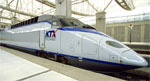 Expand Image Expand ImageConstruction of the high-speed line will connect three of Argentina’s main cities. | |
 Expand Image Expand ImageModern stations and trains will revolutionise rail travel in South America – the first high-speed line for the continent. | |
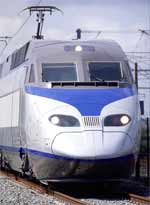 Expand Image Expand ImageThe future of Argentine rail travel? This is a Spanish high-speed set on which the new trains are likely to be based. | |
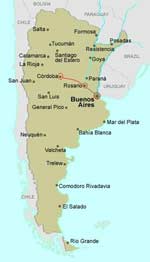 Expand Image Expand ImageThe main population centres of Argentina are served by the planned high-speed line between Buenos Aires and Cordoba. |