Lisbon-Porto High-Speed Line, Portugal


|
Journey times are being slashed between Portugal's largest cities, the capital Lisbon and Porto, with the opening of a new dedicated 329km (204-mile) high-speed line in 2004, considerably behind schedule. The Pendolino family of tilting trains intended for this route entered service as long ago as 1999. They replaced conventional trains of locomotive-hauled coaching stock and, when allowed, will see top speeds increased from the current 160km/h, cutting inter-city journey times from 3.5 hours to 2.25 hours. 
THE PROJECT Top speed rose, first to 180km/h (112mph), and by 2001 to 220km/h (135mph), the trains' potential maximum, as work progressed on upgrading the entire line for higher speeds. The major upgrading project is being overseen by REFER, a private body established to run, and oversee investment in, Portugal's railway infrastructure. The project represents an almost total renewal of the major artery linking Portugal's two largest cities. The new trains offer greater comfort and improved on-board services, as well as higher speeds. Locomotive-hauled trains have been cascaded to work slower inter-regional services on the route, or to upgrade services on other lines. INFRASTRUCTURE The upgrading involved widespread renewal of existing rails with UIC60 and 54 on monobloc and bi-bloc concrete sleepers. A number of new alignments have been constructed to ease curves, and 161 new bridges built to replace level crossings. For the project, the 336km (209 miles) route was divided into three sections, covering Braco de Prata-Entroncamento, Entroncamento-Pampilhosa, and Pampilhosa-Vila Nova de Gaia. Work on all began in the first quarter of 1998, and the project was completed by summer 2001. Meanwhile, REFER has had to ensure that, as far as possible, normal services can be maintained during the works, but this did create some problems, notably at Bobadela, where a major new railfreight hub has been built. ROLLING STOCK Ten six-car units were ordered by CP to operate the revamped services, comprising two motor vehicles, each equipped with two 510kW traction motors, and a driver's cab housed in a now-characteristic aerodynamic sloping front end. The trains are closely derived from Fiat's ETR460 third-generation 'Pendolino', first introduced in Italy, although to increase Portugese involvement the trains were assembled at the Adtranz Amadora plant rather than at Fiat’s own Savigliano plant in Italy. Bogies had to be redesigned for operation on Portugal's 1,668mm (5ft 6in) gauge track, and traction motors are mounted underfloor. Each bogie has an active lateral suspension system, and a spring parking brake. For ease of maintenance, each motor bogie and trailer bogie is interchangeable. Power comes from eight asynchronous three-phase motors, each with a 510kW power rating. The use of two independent traction motors allows a train to continue in service, at least temporarily, in the event of the failure of a single unit. Transducers on the train's front bogie pass data to the computerised control unit which governs the tilting system, which is hydraulically-powered. Each train seats 96 first class and 203 standard class passengers, with two additional spaces for wheelchairs, and driver's and passengers' compartments have independent air-conditioning systems. SIGNALLING/COMMUNICATIONS Major upgrading has also been carried out on the Porto-Lisbon route. The former relay-based automatic fixed block signalling is replaced by 31 electronic and three central traffic control installations. Information on individual services and each train's next stop is transmitted to passengers through both the train's PA system and through personal headphones at each seat. There are also three audio and one visual channel for passengers' entertainment, with pictures transmitted over central monitors arranged throughout the train. THE FUTURE A new public company, RAVE (Rede de Alta Velocidade), has been established to prepare plans for a new €5 billion high speed link (80% funded by the EU, the rest by Portgual and Spain) between Lisbon and Madrid. It would be standard gauge (1,435mm) and complete by 2015. All ten Alfa Pendular trainsets have now settled into service and shortened journey times are being offered taking advantage of the 220km/h (135mph) capability of the trains. It is planned to extend their operation to other routes, including the sharply-curved Beira Alta line to Guarda. They will not be able to work the new national airport under construction at Ota, 30km north of Lisbon, because this is being planned for standard gauge. |
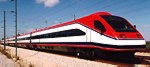  Expand Image Expand ImageThe top speed is set to rise from 180km/h to 220km/h as work is progressed on upgrading the entire line for higher speeds. |
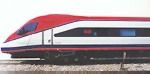 Expand Image Expand ImageThe Alfa Pendular's aerodynamic front end is designed by Giugiaro. | |
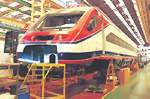 Expand Image Expand ImageBodyshells under construction at Fiat's Savigliano factory. | |
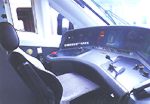 Expand Image Expand ImageThe ergonomic cab features a 'wrap-around' driver's instrument display. | |
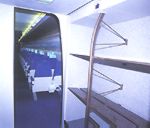 Expand Image Expand ImageLuggage racks are provided at each carriage end. | |
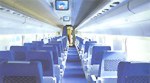 Expand Image Expand ImageA view showing the video screens which transmit in-journey information and entertainment. | |
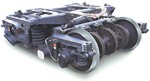 Expand Image Expand ImageBogies are interchangeable between motor and trailer vehicles. | |
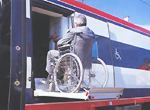 Expand Image Expand ImageAn integral fold-out lift can help passengers with access to wheelchair spaces. |