Honolulu High-Capacity Transit Corridor Project, Hawaii, USA


|
The Honolulu high-capacity transit corridor project includes the construction of a 20-mile elevated rail line linking West Oahu with downtown Honolulu and Ala Moana Center. The project is estimated to cost $5.28bn and is scheduled for completion in 2019. The federal government is providing $1.2bn towards the project. The city of Honolulu has a population of 905,034 and is growing steadily. Currently buses, boats and private automobiles are used to fulfil the transport needs of the people in the city. However, traffic congestion had increased to a large extent in recent times in the project corridor. 
A large-scale solution was needed to reduce the number of vehicles on the road and to cater to the growing transportation needs of the city. A rail transit system was considered as the best option for solving the transportation problems caused due to space constrain in the city. The city of Honolulu invited bids for the 6.5 mile initial segment of the project in February 2009. The first segment will be constructed from East Kapolei to Pearl Highlands and involves construction of track and guideway viaduct and surface restoration. The first segment is expected to cost between $550m and $600m and is scheduled for completion in 2012. The final contract for the first segment will be awarded in October 2009. Ground-breaking for the project is expected to take place at the end of 2009. The rail transit system will be reach Ala Moana Center and will later extend up to Honolulu International Airport, Waikiki, the University of Hawaii-Manoa and Kalaeloa. High-capacity transit corridor project "The Honolulu high-capacity transit corridor project includes the construction of a 20-mile elevated rail line."
The Honolulu project was conceived in 1996, but rejected several times by the city council due to the additional tax burden the project would have placed on the citizens. The project was finally approved in 2005. The primary aim of the project is to offer high-capacity rapid transit in the congested east-west transportation corridor between Kapolei and the University of Hawaii at Manoa. The area was identified as a bottleneck for smooth flow of traffic under the Oahu regional transportation plan for 2030 (ORTP 2030). ORTP 2030 is a guide to handle the mobility issues and transportation demands of the city. The city council conducted an environmental impact assessment study to evaluate whether an elevated rail transit system was the only option to solve the transportation problems of the city. Four options were considered in the study – a no-build alternative, a transportation management system, express buses operating in managed lanes and a fixed guideway transit system. The study concluded that a fixed guideway transit system would be the best and most cost-effective solution for serving the long-term needs of the people of the city. The project is expected to provide a fast and reliable public transportation service compared to buses running in congested mixed flow traffic. It will also provide secure mobility in rapidly developing areas of the corridor and in regions where small income groups and elderly population live. The project will also create additional transit capacity, serve as an alternative to private automobile travel and improve transit links within the corridor. Construction is expected to generate 11,000 jobs in addition to increasing the state and city's revenues. The rail link will also help keep about 25,000 cars off the roads and highways in Oahu every day. By 2030 the project is expected to reduce traffic congestion by 11%. Honolulu infrastructure The city issued a request for information (RFI) to help select the right technology for the transit system in January 2008. Four alternative technologies – monorail, rubber tired, steel wheel / steel rail and urban maglev – were considered. Advanced Public Transport Systems, Alstom Transport, AnsaldoBreda Transportation, Bombardier Transportation, Hitachi America, IHI, Mitsubishi-Itochu, Mitsubishi-Sumitomo, Siemens Transportation Systems, Thales and Translohr responded to the RFI. After evaluating various options presented by the companies, the steel-wheel rail system was considered as the best option for the project. "A rail transit system was considered as the best option for solving the transportation problems in Honolulu."
The rail transit system will be powered by electricity generated from renewable sources and supported by the Sierra Club, an environmental organisation in the US. The guideways of the project will be 30ft high in most regions and about 50ft high, including vertical circulation, at stations. The guideways will be supported by 6ft-diameter columns about 150ft apart. Railway stations will also be elevated and equipped with elevators or escalators and will be totally ADA accessible. Railway stations will be about 270ft long and will be located at one-mile intervals. The city plans to issue a request for proposals for the final design of the railway stations and for maintenance yard construction. Acquisition of 44 properties for the narrow right-of-way, and procurement of vehicles, traction power and train-control systems will also be carried out in 2009. Construction of the Waipahu transit centre is expected to start in 2011 and work on the West Loch station is expected to begin in late 2011. The first service from Waipahu will begin in late 2012. Rolling stock The trains of the Honolulu transit system will include 200ft-long electric, steel-wheel trains with an average speed of 30mph. The trains will be able to carry 300 passengers each. Every hour the trains will transport more than 6,000 people, with the number expected to reach 90,000 a day by 2030. |
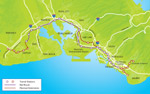  Expand Image Expand ImageRoute of the Honolulu high-capacity transit corridor project, which will link West Oahu with downtown Honolulu and Ala Moana Center. |
 Expand Image Expand ImageThe city of Honolulu has a population of 905,034 and is growing steadily – hence the need for an improved transportation system. | |
 Expand Image Expand ImageA large-scale solution was needed to reduce the number of vehicles on the road and to cater to the growing transportation needs of Honolulu. |