Mardones BPB Creosote Treaters - Hardwood Sleepers, Bridge Timbers and Crossing Timbers for the Rail Industry


|
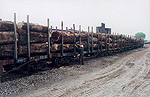
In 1993, Mardones, the largest railway hardwood sleeper / railroad crosstie producer in Chile, joined forces with the Burke-Parsons-Bowlby Corporation, a major US railroad crosstie manufacturer, and created Mardones - BPB Creosote Treaters. The company built a new treating plant in Chile and have since, from this facility, provided several railways with open track sleepers / ties, bridge timbers and crossing timbers / turnout sleepers / switch ties. Mardones - BPB Creosote Treaters currently serve in many different regions such as Saudi Arabia, Egypt, Korea, South Africa, New Zealand, Peru, Costa Rica, Colombia, the USA and Chile. Open track sleepers, bridge timbers and crossing timbers for the rail industryEvery sleeper produced at Mardones – BPB's plant meets both the American Railway Engineering and Maintenance of Way Association (AREMA) and American Wood Protection Association (AWPA) standards, and is obtained from sustainable managed forests. Exported shipments are inspected by Intertek Caleb & Coprof, a third-party independent auditor, assuring the accomplishment of customers’ standards and specifications. Mardones – BPB's treating plant is located close to Concepcion Bay where three large ports move the equivalent of almost one million 20ft sea containers per year. The plant was constructed and is currently operated in line with the US Environmental Protection Agency (EPA) standards. Goods for freight-heavy haul tracks and high-speed passenger linesChilean laws enforce severe regulations in order to guarantee the native forest’s sustainable management. There is 13.4 million hectares dedicated to commercial usage, leaving 19 million hectares protected and dedicated as public forest parks. Every good produced by Mardones - BPB has been obtained under government control, taking good care of nature. The selected forest species are Chilean Oak and Chilean Beech, which have mechanical properties that permit sleepers to fully satisfy AREMA requirements (Chapter 30, Appendix A Crosstie Performance Matrix). These species have a proven durability for freight-heavy haul tracks, with an annual tonnage of over 50mgt, as well as in high-speed passenger lines (160km/hr) in both standard (1,435mm) and broad (1,676mm) gauge. Creosote impregnation process for railway timbersThe creosote impregnation process is a vacuum–pressure procedure performed in accordance with the guidelines provided by the AWPA and meet the standards of U1-09, T1-09, P1/P13-09, P2-09, P3-09 and P4-09. Through this procedure, it is possible to sterilise timber, eliminating wood-eating organisms (fungi and insects present in any form), as well as sealing it with a water-repellent, anti-fungi, insecticide solution (creosote), which prevents rot and decay. This considerably extends the service life of untreated wood (UIC 863 – 1OR, page 6 and AREMA Chapter 30, Section 3.6, page 29). Timber machiningEvery wooden sleeper is incised following AREMA specifications before stacking it on the seasoning storage and treating it. Anti splitting devices such as AREMA multi-gang nail-end plates could be provided upon the customers’ requirement. Adzing and pre-boring is also available.  Contact Details Contact Details
Mardones BPB Creosote Treaters
Tucapel 2045 – La Pintana Santiago Chile Tel: +56 2 5428063 Fax: +56 2 5450836 Email: info@mardonesbpb.cl URL: www.mardonesbpb.cl |