



 |

|
|
 09.12.2023, 06:53
|
#1 (ссылка) |
|
Crow indian


Регистрация: 21.02.2009
Возраст: 41
Сообщений: 30,470
Поблагодарил: 398 раз(а)
Поблагодарили 6057 раз(а)
Фотоальбомы:
2624 фото
Записей в дневнике: 911
Репутация: 126141
|
Тема: Safe Digital Platform 2.0 for ZAT systemsSafe Digital Platform 2.0 for ZAT systems K. D. Khromushkin, Deputy General Director for Innovative Development and Digital Transformation - Director of the ZhAT Division, “Group of Companies 1520”, M. V. Fomin, technical director of CyberTech-Signal, E. V. Pavlov, Deputy General Director of the company “1520 Signal” [color="Blue"]The CyberTech-Signal company of the ZhAT division of the 1520 Group of Companies has developed a secure digital Platform 2.0, on the basis of which systems for controlling and ensuring the safety of train traffic, as well as automated control systems for technological processes in other industries can be created . Innovative approaches to the construction of software and hardware ensured the universality of Platform 2.0, its functional flexibility and technological independence. The division of ZhAT "Group of Companies 1520" unites a number of leading Russian companies, such as "ELTEZA", "1520 Signal", "Stalenergo", etc., which occupy leading positions in the field of railway automation and telemechanics for railway, industrial and urban rail transport . The train control systems supplied by these companies are widely used on the railways of Russia and other CIS countries. Formed in 2018, the CyberTech-Signal company, as part of the ZhAT division, performs tasks related to R&D and support of digital train control and safety systems produced by the division when there is a need for developer intervention, for example, if it is necessary to expand the functionality of systems or create new ones components to replace existing ones whose life cycle is coming to an end. Developing Platform 2.0 as a next-generation product, the CyberTech-Signal company pursued the goals of achieving maximum modularity of hardware and software, radically increasing system performance and increasing its functionality, including in terms of diagnostic capabilities compared to existing more conservative technical solutions.[/ COLOR] General concept of Platform 2.0 The structure of Platform 2.0 includes three levels (Fig. 1):
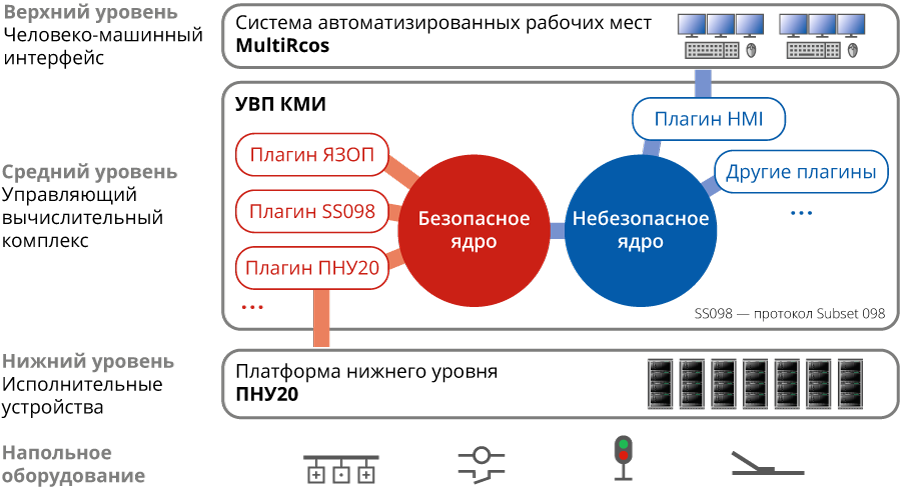 While remaining within the framework of this classical structure, the developers significantly revised the existing approaches, primarily to the software architecture of the digital platform. Workstation system At the upper level of the new platform, a system of automated workstations is used on the MultiRcos software developed by the division, which is the most common workstation system in the “1520 space”. An innovation was the porting of MultiRcos in order to ensure its cross-platform functionality as part of the transition to Russian operating systems. Cross-platform allows you to run MultiRcos software in both the Windows operating system and the Russian RED OS, as well as in other Linux-like POSIX-compatible operating systems. Currently, all tests have been carried out and all conclusions have been received for the RED OS operating system, included in the Russian software register. At the same time, cross-platform allows you to switch to another POSIX-compatible OS if the customer wishes. Control computer complex Middle level forms the control computer complex (UCC) VMK20 - MC , hardware security whom built on database universal com*Иванов**Иванов**Иванов**Иванов**Иванов*g platforms component - modular execution UVP KMI . IN case applications V systems running _ responsible functions , UVP KMI It has two-channel execution With hot reservation . The Elbrus operating system is used as system software. The diversity of the system software is ensured by compiling the UVK KMI com*Иванов**Иванов**Иванов**Иванов**Иванов*g channels for different processors. The basic software of the complex was written by CyberTech-Signal specialists from scratch in the form of a plug-in system in which individual plug-ins function and communicate through a secure kernel (Fig. 2). This approach, based on a modern service-oriented architecture with elements of a microservice model, has significant advantages over the monolithic base software traditionally used in the MPC in terms of ease of maintenance and changes. It becomes possible to maintain and develop individual modules independently of each other and from the secure core of the base software. 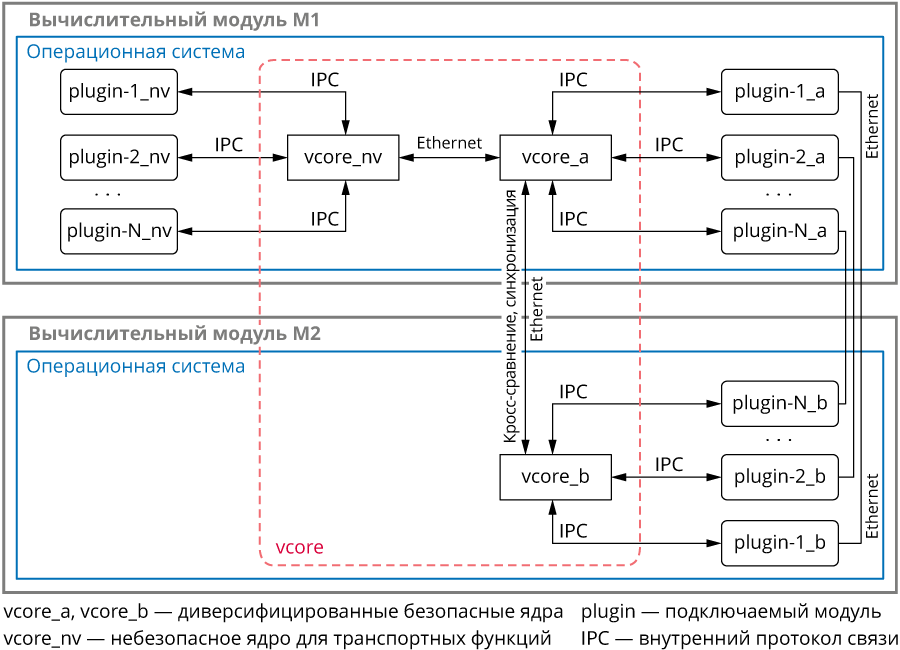 Architecture of the basic software of the control computer complex To ensure the diversity of the base software and eliminate systematic errors, it was developed by two different teams of specialists. Along with the secure core, the base software includes plugins responsible for implementing centralization logic, interaction with automated workstation systems and object controllers, as well as other critical functions or functions that do not affect security. In particular, one of the developed plugins implements the Subset 098 protocol, used to exchange information with adjacent centralization systems and radio blocking centers. The implementation of individual functions using plugins allows you to reduce the cost of developing and adapting basic software for a specific project. For example, if a facility uses rolling stock axle counters to monitor track vacancy, then the corresponding plug-in is added to the base software and the connection plug-in with track circuit monitoring modules is removed. Included in the software VMK20 - MC included Also technological software that provides safe calculation dependencies And consisting from two components . One from them describes specific objects control , the other - communications between objects By geographical principle , i.e. _ e . description specific stations . To develop technological software, the CyberTech-Signal company created two programming languages - YAZOP (object logic) and STOYAZ (communications between objects). They are similar to widely used programming languages, such as C++, which makes it possible to involve in the preparation of technological software not qualified programmers-developers, but technologists - specialists in the field of signaling systems, using the RailCAD computer-aided design system created by the ZhAT division. Lower level actuators The PNU20 lower-level platform is also a development of the CyberTech-Signal company. It uses object interface devices (OUDs), which implement the functions of object controllers and control arrows, traffic lights, relays, etc. Event-driven approach A study conducted by CyberTech-Signal before the start of the development of Platform 2.0 showed that events at railway stations occur relatively rarely and do not create a significant load on the com*Иванов**Иванов**Иванов**Иванов**Иванов*g modules. This made it possible to implement one of the key innovations of Platform 2.0 - the event-driven approach. The essence of this approach is that dependencies are calculated when an event occurs and within the zone affected by this event. For example, if an event occurred in one station neck, there is no need to recalculate dependencies for another neck. The event-based approach, implemented in a safe kernel, the language of the language and object controllers (object communication devices - OCD), made it possible to significantly, up to tens of milliseconds, reduce the system response time, which is now determined mainly by the object controller cycle and the quality of the data transmission network. Naturally, when the system is initialized, the response time increases. At the same time, it remains possible to use devices in the system that are oriented towards cyclic data transmission, such as track circuit monitoring modules or axle counting systems. The choice in favor of an event-oriented approach entailed a transition to an asynchronous data exchange protocol between the control com*Иванов**Иванов**Иванов**Иванов**Иванов*g complex and the PNU20 platform. UVP KMI com*Иванов**Иванов**Иванов**Иванов**Иванов*g platform UVP KMI is a universal system that can be used not only in railway transport, but also in the energy sector and other industries. Structurally, the UVP KMI consists of a 19 ‑ inch block frame format "Euromechanics -3U " , in which are placed separate modules - block power supply , communication module And kits com*Иванов**Иванов**Иванов**Иванов**Иванов*g modules M 1 and M 2, a Also reserve kits ( Fig . 3). Safety UVP provided behind check two-channel execution By scheme 2 (2 out of 2). Com*Иванов**Иванов**Иванов**Иванов**Иванов*g modules M 1 and M 2 built on Russian processors _ 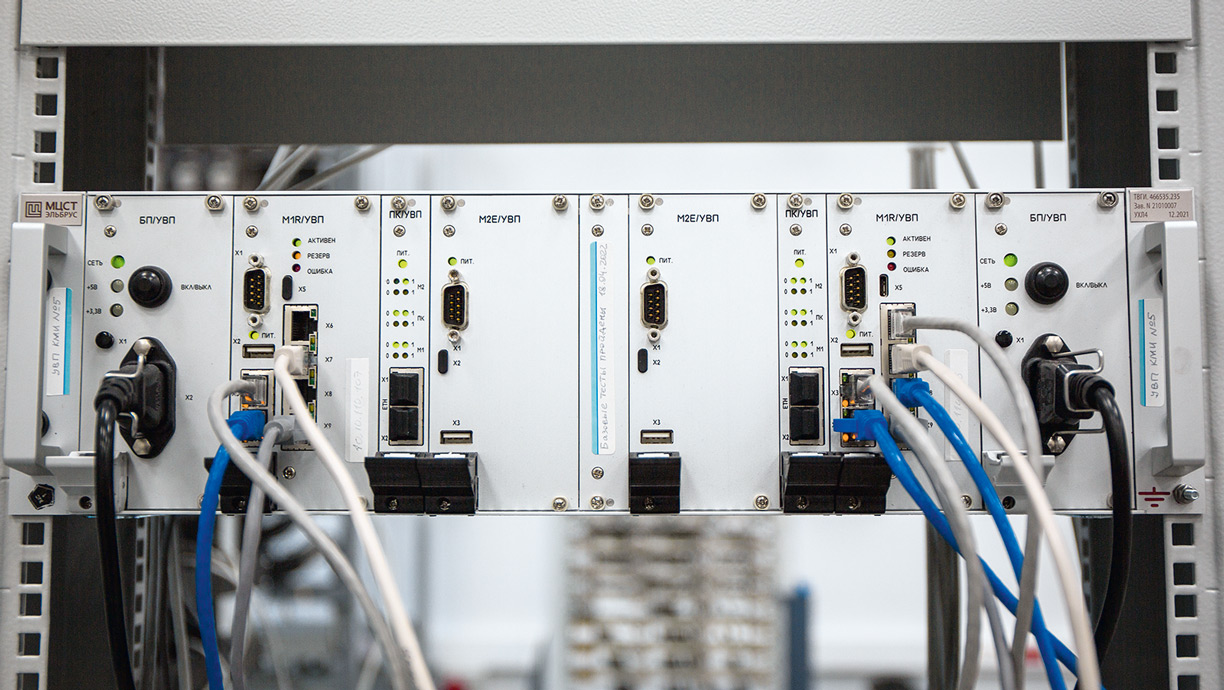 Universal com*Иванов**Иванов**Иванов**Иванов**Иванов*g platform UVP KMI The platform was developed by Russian industry according to the technical specifications of CyberTech-Signal. The UVP KMI concept allows the use of other processors, including those manufactured by Intel and based on ARM architecture. Lower level platform PNU20 The PNU20 platform is structurally designed as a standard 19 ‑ inch block frame 6U high with built-in unifying fee OP PNU 20. V him are placed two network boards KDFP And executive boards USO miscellaneous appointments on hardware ensuring Russian production _ One frame can accommodate up to 19 devices (Fig. 4). To ensure security, all USOs are equipped with two microcontrollers with diversified software. All boards support hot backup. 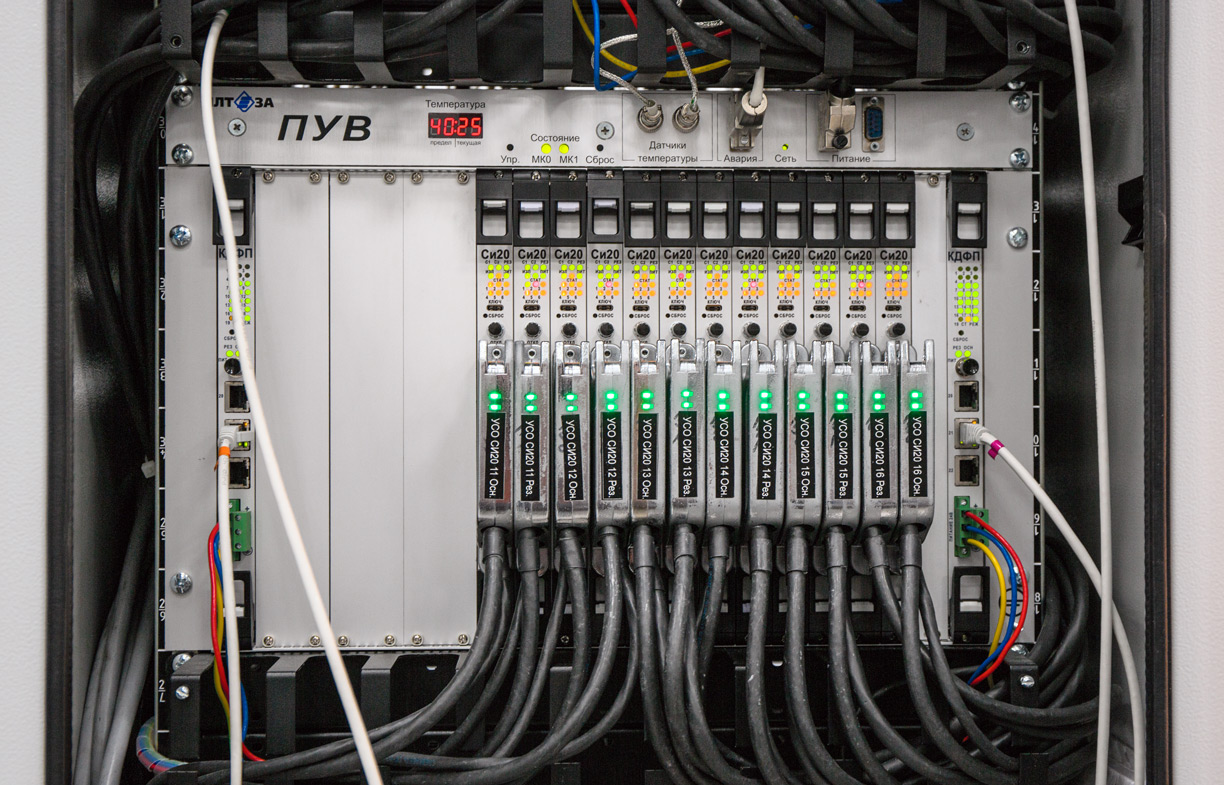 Lower level platform PNU20 For the PNU20 platform, four types of USO have been developed: switch St20, traffic light Si20, interfaces with relay contacts Rk20 and relay windings Ru20 (Fig. 5). All these USOs are universal - for example, the St20 device is capable of controlling a arrow (or paired arrows) using a two-, three-, five-, seven- or nine-wire circuit, and the Si20 device is capable of controlling six traffic light lamps. 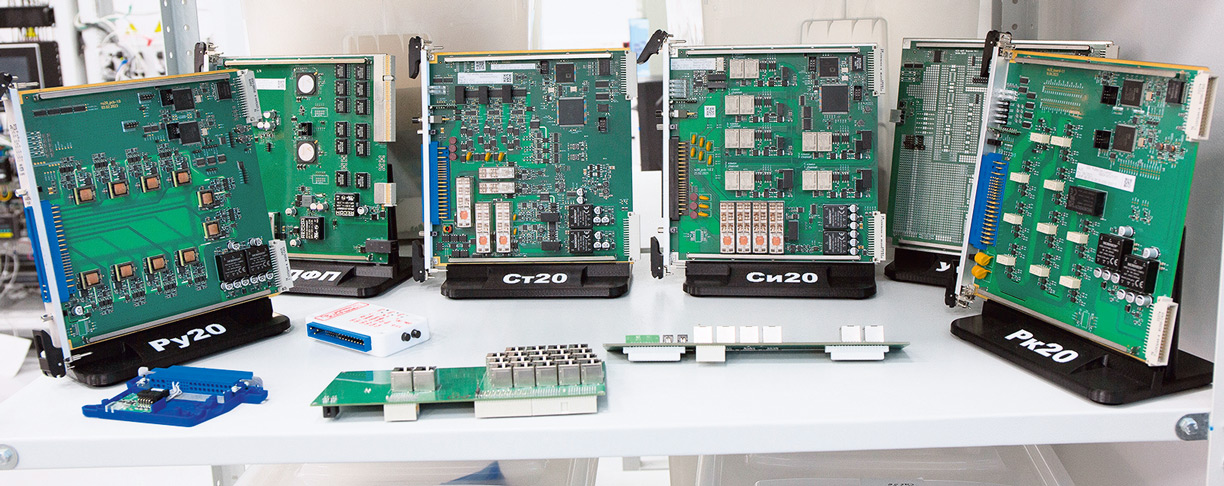 PNU20 lower level platform boards When developing USOs, special attention was paid to their reliability and safety. As a result, for example, the mean time between failures of the St20 device is more than 100 thousand hours. The device is configured using a smart connector on a specialized cable. A highly reliable microcircuit is built into this connector, into which the programmer writes configuration data along with the address of a specific floor-standing device. Accordingly, to replace the USO, it is enough to replace the universal board and reconnect the smart connector. The concept of the PNU20 platform includes the possibility of using a module that is installed in its block frame and is capable of performing the functions of a control computer complex at small stations and crossings. Trial operation of such a com*Иванов**Иванов**Иванов**Иванов**Иванов*g module is planned for 2024. Implementation, development prospects and areas of application of Platform 2.0 For Platform 2.0, a certificate of compliance with safety integrity level SIL 4 (SIL4) has been obtained. Platform 2.0 software has passed an information security audit and is registered in the Russian software registry. The release of microprocessor centralization for specific implementation objects is carried out by the Elteza company, which carries out design, development of technological software and assembly of the system. The MPC-EL system based on Platform 2.0 has been in operation at the Panteleevo station of the Northern Railway since December 2022. Having developed Platform 2.0 by the CyberTech-Signal company, the ZhAT division of the 1520 Group of Companies was able to create a variety of railway automation and telemechanics systems based on a compact unified hardware and software complex with a high level of modularity, flexible functionality, high reliability and safety, and advanced diagnostics . Based on Platform 2.0, MPC systems can be developed in an optimal configuration for stations of any size, train interval control systems (including with data transmission via radio channel) and other automation systems on mainline and industrial railways, as well as on urban rail transport. The areas of application of Platform 2.0 are not limited to rail transport. On its basis, automated control systems for critical technological processes in the energy sector and other industries can be built. |

|
Цитировать 14 |
 Похожие темы
|
||||
| Тема | Автор | Раздел | Ответов | Последнее сообщение |
| =Книги= Dynamics of Railway Vehicle Systems (Garg V.K., Dukkipati V.R.) | Admin | Книги и журналы | 0 | 09.02.2014 07:15 |
| Статья председателя UIC ERTMS Platform Питер Винтер | tiksi | Статьи по СЦБ | 0 | 16.01.2014 11:31 |
| Power supply systems of devices STSB | Толян | Wiki | 0 | 05.09.2010 13:45 |
| Ответить в этой теме Перейти в раздел этой темы Translate to English |
| Возможно вас заинтересует информация по следующим меткам (темам): |
| Здесь присутствуют: 1 (пользователей: 0 , гостей: 1) | |
|
|


 Почта
Почта


