About auto mode for freight wagons
V.N. Murtazin, Candidate of Technical Sciences,
I.I. Arkhipov
In the 50s of the last century, wagons were equipped with air distributors 135 and 270-002. They had three cargo modes — "empty", "medium" and "loaded". The "empty" mode was activated when loading a wagon of less than three tons per axle, the "medium" mode was activated when loading from three to six tons per axle, and the "loaded" mode was activated when loading from six tons per axle or more.
These requirements were developed when the wagons were produced with cast-iron brake pads and a load of 20.5 tons. The air distributor was switched to the "loaded" mode for a wagon with a 22-ton container and 24 tons of cargo were loaded, or 56% of the maximum weight of the wagon.
Such wagons often had wheelset skidding during maximum braking. In mixed trains consisting of empty, partially and fully loaded wagons, the longitudinal forces reached the maximum permissible values.
Therefore, in order to avoid damage to the wheelsets by sliders, canopies, etc., as well as to remove restrictions on the possibility of driving mixed trains of increased length, it was decided to equip freight wagons with auto modes. At the same time, the braking distance of a car with jammed wheelsets increases up to four times relative to the braking distance of the same car with normal brakes. That is, the car becomes practically non-braking at the entrance to the SW.
The first domestic auto mode 265.002 was designed to work with cast iron brake pads. The range of air pressure control in the brake cylinders, depending on the load, ranges from 1.0 to 4.0 kgf/cm2. The transition to maximum pressure and "loaded" mode occurs when the damper stop is raised, corresponding to 90% of the maximum load of the car.
In the 70s, the following measures were carried out in the USSR when transferring the fleet of freight wagons from cast-iron brake pads to composite ones:
- the lever gears of the wagons have been changed (the gear ratio has been reduced by 1.6 times);
- the maximum pressure in the brake cylinders of loaded wagons has been lowered from 4.2 to 3.0 kgf/cm2;
- the ranges of switching cargo modes of air distributors have been changed, instead of three there are two — "empty" and "medium". Switching modes to "medium" — when loading from 6 tons / axle or more, to "empty" — when loading less than 6 tons /axle. As a result, the maximum pressure in the "empty" mode was increased from 1.3 to 1.6 kgf/cm2.;
- instead of auto modes 265.002, auto modes 265A were installed (their pressure control range in the brake cylinder decreased, from 1.4 to 3.0 kgf/cm2. Switching occurred when the stop was raised to 19 mm, which was approximately 50% of the maximum load of the car.;
- to avoid confusion, to calculate the braking efficiency of the train, the calculated pressing forces of the composite pads on the "empty" were 3.5 tc and on the "medium" 7.0 tc, the same as for cast—iron pads on the "empty" 3.5 tc and on the "loaded" 7.0 tc.;
- The following phrase was added to the Operating Instructions for brakes of rolling stock of railways No. CV-CT-VNIIZhT/2899, 1971: "For freight wagons equipped with composite brake pads, it is forbidden to turn on the air distributor in loaded mode."
As a result of the implementation of these measures, the braking force of freight wagons equipped with composite brake pads instead of cast-iron ones has increased.:
- for empty wagons with the air distributor switched on to "empty" mode — 1.64 times;
- for loaded wagons, when the air distributor is switched on to the "medium" mode, it is 1.43 times.
The grip margin between the wheel and the rail has been drastically reduced. As a result, the amount of damage to the surface of the rolling wheels by brake defects has increased many times compared to the time when the wagons were equipped with cast-iron brake pads.
It was even necessary to introduce restrictions on the formation of mixed trains. Empty wagons are allowed to be placed only at the rear of the train, as the traction reserve of the wagons has greatly decreased or disappeared.
To reduce the cases of damage to the wheels by braking defects and to avoid an increase in the braking distance due to the entry of the wheels into the skid, it is necessary to install auto modes on all cars. This will smoothly increase the pressure in the brake cylinder as the load of the car increases, and the maximum pressure (3.0 kgf/cm2) should be set at 80% of the maximum allowed load.
With permissible deviations in the parameters of the springs of the spring sets and displacements of the center of mass of the car, the maximum pressure in the brake cylinder of a fully loaded car will be set. The wheel's grip on the rail will increase almost as much as that of wagons with cast-iron brake pads.
The auto modes of the 265A-1 and 265A-4 series have the same design, differing only in the working stroke (the distance between the centers of the pistons and the internal displacement of the damper), the use of Plastm grease in the 265A-4 and Teflon coating of the working surfaces of the pistons. The use of lubricant and Teflon coating increases the stability of sensitivity and reduces the likelihood of corrosion.
Structurally, the 265 series auto modes have three disadvantages.
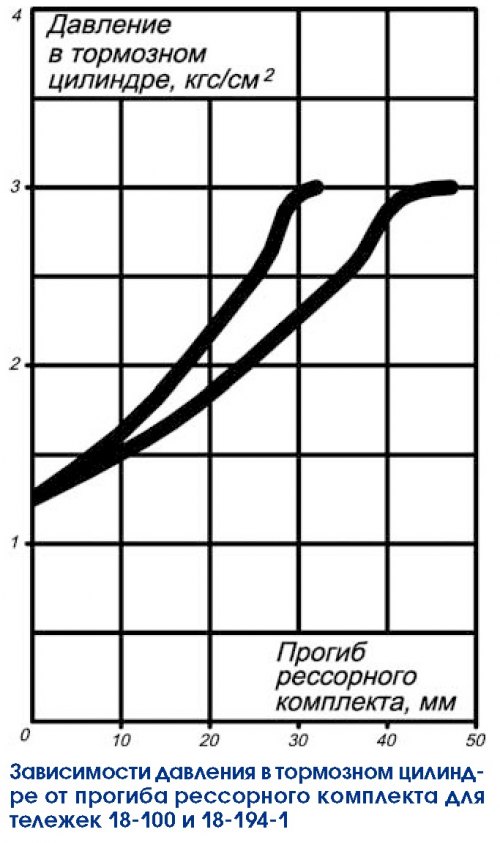
The working stroke when switching from an empty pressure of 1.4 to a maximum of 3.0 kgf/cm2 is limited by the distance between the piston centers (the working stroke of the 265A is 1 ~ 20 mm, and that of the 265A is 4 ~ 24 mm).
The change in the distance from the support platform under auto mode from the empty to the loaded state, depending on the variation of spring spring stiffness deviations (within the tolerance limits) and the displacement of the center of mass of the load, is:
- for trolleys 18-100 — from 30.6 to
50.3 mm;
- for trolleys 18-578 — from 45.3 to
67.4 mm;
- for bogies 18-194-1 — from 50 to 70 mm.
Considering that bogies 18-194-1 have a bilinear characteristic of the spring set, switching, even at nominal spring spring stiffness values, occurs when loading 26% of the load capacity. Therefore, the 265 series auto modes can only be used on wagons with 18-100 bogies and an increased center distance for pistons up to 160 mm.
The center-to-center distance of the pistons in 265A—1 is 106 mm, and in 265A-4 it is 130 mm. They cannot be used on wagons with bogies 18-578 and 18-194-1 due to the need to increase the center-to-center distance of the pistons to 260 mm, as very large dimensions will result.
The small maximum division coefficient is the conversion of the inlet pressure into the pressure in the brake cylinders of an empty wagon, defined as the ratio of the pressure in the brake cylinder to the inlet pressure of an empty wagon. Today, it is equal to 2.1 (3.0/1.4 kgf/cm2) for almost all wagons. For auto modes 265A-4, it can be increased to 2.5 (3.0/1.2). With further increase, due to the design features, it becomes very unstable.
The purpose of auto modes is to adjust the braking force of the car depending on the load on the rail and strive to obtain a specific braking force that is the same in all cars. To do this, in wagons with a load of 25 tons and a container of 24 tons, the division coefficient should be 4 (100/24), and taking into account the decrease in the coefficient of friction of the brake pads, with increasing pressure, it should be 5.
For wagons with a load of 27 tons and a container of 18 tons, the division coefficient is 6 (108/18), and taking into account the reduction in the coefficient of friction, it is 7.
The 265 series auto modes very poorly meet the requirements of wagons with a load of 23.5 tons and do not meet the requirements of promising wagons with a load of 25 tons or more, as well as wagons with a reduced container.
Low reliability — when the movement of the damper by the amount of the displacement of the support pad, with all the fluctuations of the spring set, leads to a change in the internal volume of the cavity in which the lever, cracker, etc. are located. The air pressure in this cavity increases and decreases.
As the rod moves upward, the volume of the cavity decreases, the air pressure increases, and it exits into the atmosphere. When the rod moves downwards, the reverse process occurs — air from the environment enters this cavity, i.e. a "pump" is obtained.
Since a loaded wagon has large amplitudes and frequencies of vibrations of the spring set, the damper rod moves with such fluctuations. Dust and snow are intensively sucked into this cavity, which settle between the guides, damper rods and pistons. In this case, even the damper rod jams in the upper position. Therefore, auto modes, although several million of them have been produced, have very low reliability.
So, from 2004 to 2007, employees of the Scientific and Technical Center "Wagon-Brake" annually checked at the UKAR-2M automatic stand from 750 to 960 auto modes 265A and 265A-1, removed from wagons that entered the depot. Of all the tested auto modes, about 95% were rejected.
During a commission inspection on December 11-12, 2006 at the Costa station of the Northern Road of semi—trailers model 12-132-03 equipped with 265A-4 auto modes, it was revealed that 18 out of 22 were defective, which is 81.8%.
According to the Gorobrazdatskaya carriage repair depot, more than 30% of the 265A-4 auto modes that have been scheduled for repair have fractures of the bolt securing the cracker and the lever. These are the most dangerous brake equipment failures. During braking, the brake cylinder is filled with compressed air with a maximum pressure of 0.35 kgf/cm2 and no longer rises.
At this pressure, the brake cylinder rod comes out, the brake pads are pressed against the wheels, but very weakly, since there is no braking force. In operation, this malfunction is practically impossible to detect.
From 1987 to the end of the 90s, after several freight train crashes, the 265 series auto modes were not installed on the wagons, but were dismantled during repairs. As a result, in the late 90s, more than 30% of the cars in the operational fleet were without auto modes.







 05.07.2022, 03:59


 Похожие темы


 Почта
Почта