Milan Urban Transit, Italy


|
Part of a densely populated area of Lombardy, the city of Milano (Milan) is of great economic significance. At a transport crossroads of routes south from the Alps and east-west across northern Italy, Milan's position and history have made it a long established part of the European trading and cultural mainstream. Established in 1931, the authority for Milan's urban transport – other than for heavy rail services – is Azienda Trasporti Milanesi (ATM). They are responsible for a 1,400km network covered by a three-line metro (Metropolitana), around 120 lines worked by a combination of tram, trolley bus and bus, with powers also extending to aspects of parking. It also sells transport management expertise to other authorities. 
ATM further extended the scope of its operation in 2008 when, under the INMETRO brand, a joint venture with Ansaldo STS, it took over operation of the Copenhagen Metro. THE PROJECT "The tram system is one of Europe's largest, but much of it shares space with road vehicles and is accordingly caught up in the prevalent congestion."
The city can experience high levels of airborne pollution related to Milan's prosperity, being surrounded by autostrada/motorways and with a leaning towards heavy car use. Increasing the capacity and patronage of public transport is thus seen as a long-term challenge to planners. In spite of the scale of Milan's public transport, coverage by the faster rail-based modes is inconsistent, with some urban areas lacking such services. The tram system is one of Europe's largest, but much of it shares space with road vehicles and is accordingly caught up in the prevalent congestion. In addition to ATM, main providers of rail services are the national body Ferrovie dello Stato (FS) as Trenitalia, and the sizeable FNM (formerly Ferrovie Nord Milano Trasporti), whose regional and suburban transport passenger services are being rebranded as LeNord. INFRASTRUCTURE With the vast and elaborate Stazione Centrale towards the east of the central area as principal rail gateway, Milan also has other city stations handling heavy rail services including designated suburban (S) and regional (R) routes. These lines are equipped with the Italian standard electrification of 3,000Vdc overhead supply. Providing greater operational flexibility and reducing the volume of interchanges at termini, the underground Passante Ferroviario line running north-west to south-east opened as a through route in late 2004. In planning and construction for many years, the completed Passante carries suburban traffic of Trenitalia and LeNord and is not thus far integrated with long-distance services. With around two thirds the length of its 1940s peak of 310km, parts of the tramway are traditional in nature with much street running, especially in the centre where many routes provide intensive coverage. Improvements have been made to give clearer runs for the trams however, and the later light rail format introduced in early 2003, Metrotramvia (Metrotram) further out from the central area is being extended from its present lines (4,7 and 15) with the Milano Lagosta – Cinisello Monte Ortigara line due to open in 2008. ROLLING STOCK As with San Francisco with cable cars or London with red double-decker buses, Milan has forged part of its wider identity upon the four-axle Peter Witt/Carrelli tram (or Ventotto – from 1928) which remains the numerically superior type in the total fleet of around 500. Greater capacity started from 1955 with the advent a series of six- and eight-axle trams culminating in the 'Jumbo' 4900 series. Low-floor services began with 26 Adtranz (later Bombardier) Eurotrams delivered from 1999. Most modern trams are the AnsaldoBreda Sirio which like the Eurotrams are also deployed on Metrotramvia lines. The Metro lines use several builds of original equipment and there is a new design, 'MNG' (Metropolitana di Nuova Generazione), under development. SIGNALLING AND COMMUNICATIONS In March 2007 ATM awarded Alstom a €68m contract for renewing the signalling and the installation of continuous radio links to raise capacity by 30% increase on Metro Line 1. From 2007 ATM has involved telecommunication companies is a project to extend the coverage for mobile phones of metro users, with coverage indicated by stickers at the growing number of stations and tunnel sections so-enabled. Indicative of its standing internationally and of the care taken with public relations, ATM's website English section extends far beyond purely functional communications about using the system. THE FUTURE During 2008 there will be an increase to ten designated suburban routes (designated S1-S10) being operated variously by Trenitalia and LeNord to termini or via the Passante. The most significant future projects for increased urban mobility relate to the expansion of the Metro network. Existing lines all have extension work in progress or in planning. With openings due between 2009 and 2011, there will be an extra 2km for Line 1, 4.7km for Line 2 and 3.9km for Line 3. "During 2008 there will be an increase to ten designated suburban routes."
Now under construction, the wholly new nine-station Line 5 is Italy's first underground rail project to be financed through a public private partnership, the contract valued at €502m. Similar to ATM/Ansaldo's Copenhagen operation, it will feature automatic operation and platform-edge doors. It will run for 5.6km from a terminus at Garibaldi (for Metro interchange and LeNord and Passante connections) to Bignami. Opening is due by 2012, with a longer-term target destination of Monza two years later. Due for completion by 2015, another automatic 'light metro', Line 4, will be opened in stages to a 14.7km length from the western suburb of Lorenteggio to Milan's city-based airport, Linate in the east. With completion of lines 4 and 5, there is an expectation of reducing car journeys by almost 90,000 daily. As at March 2008, Milan was awaiting response to its bid to host Expo 2015, in final competition with Izmir, Turkey. Further infrastructure and service changes will be implemented if Milan is successful. |
  Expand Image Expand Image'Peter Witt' tram by La Scala – the Ventotto is the numerically dominant type in the ATM fleet. |
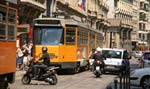 Expand Image Expand ImageOften impeded by traffic, the tram network intensively covers the city centre. | |
 Expand Image Expand ImageDeployed on long-established lines and the faster Metrotramvia sections, Ansaldo units are ATM's most modern tram. | |
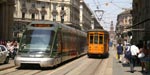 Expand Image Expand ImageEurotrams (retrospectively classified as Bombardier Flexity Outlook) were Milan's first low-floor trams. | |
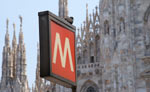 Expand Image Expand ImageTwo of Milan's three metro lines interconnect at the much-visited Duomo (cathedral), Galleria and La Scala area. | |
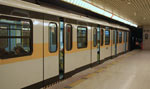 Expand Image Expand ImageExpanding Milan's Metro coverage is vital if the public transport system is to realistically reduce car use. | |
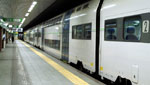 Expand Image Expand ImageMany years in planning and creation, the cross-city Passante carries some of Milan's suburban rail traffic. | |
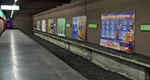 Expand Image Expand ImageProviding interchange with suburban services and the Passante, the new Metro Line 5 will terminate at Garibaldi. | |
 Expand Image Expand ImageUnlike Milan's larger airport, Malpensa, the older Linate is part of the city and will be Line 4's eastern terminus. |