Kaohsiung Metro, Taiwan


|
Kaohsiung Metro is a mass rapid transit system in Kaohsiung, Taiwan. Kaohsiung is the second-largest city in Taiwan. Taiwan is also on the verge of introducing its new high-speed train service, further enhancing travel prospects within the country. In efforts to reduce the heavy reliance on road transport within its city centre, the Kaohsiung Rapid Transit Corporation (KRTC) has developed a 42.7km network of two lines, which is the first stage of a much larger system. 
Massive and unprecedented population growth in Kaohsiung – a major industrial and port centre, situated on the south coast of Taiwan – has driven the need for a high-capacity metro in an area which is now home to three million people. The cost of the project was about US$7bn and received 90% funding from the central government. The projectThe start of construction took place in 2001 with a ground breaking ceremony. The two lines, Red and Orange, comprise 37 stations with an interchange at Formosa Boulevard. The project management and assistance services were provided by Systra. "The Red Line was opened on 9 March 2008 and the Orange Line was opened on 14 September 2008."
The Red Line was opened on 9 March 2008 and the Orange Line was opened on 14 September 2008. Kaohsiung Metro is being operated by KRTC under a build operate and transfer (BOT) contract. The BOT was signed between KRTC and Kaohsiung City Government. KRTC's aim, however, was a 2007 opening date, which was two years later than the very first estimates for its completion. The entire system features automatic operation, negating the need for drivers. Line routes The Red Line runs north-south and connects 23 underground stations, one elevated station and two depots. Siaogang and Chiaotou are its terminals. The total length of the line is 28.3km, of which 19.8km is underground and 8.5km is elevated. The line originates in Siaogang at the intersection of Yanhai and Hanmin Roads. It then passes along Jungshan, Kaohsiung City, Boai Road and ends at Chiaotou. The Orange Line is 14.4km long, running along the east-west axis. The line connects 14 stations and a main depot. Hsitzuwan and Daliao are its terminals. The line originates at Hsitzuwan on the west and passes through Jungjeng Road, Fengshan City, Taliao and ends at Daliao in Kaohsiung County on the east. The two lines together make up the 42.7km-long metro line, of which 80.1% is underground and 19.9% elevated. InfrastructureThe Kaohsiung metro uses a standard 1,435mm gauge track laid with UIC 60 rail and elastic supporting system to absorb vibrations and therefore reduce the noise of trains. The railway is designed for a maximum operational speed of 90km/h (56mph), but trains will have a maximum speed of 80km/h (50mph). At depots, the design speed will be a maximum of 35km/h (22mph), although trains are likely to be limited to 25km/h in this area. In order to build the system below ground, two tunnelling methods were employed. Cut-and-cover tunnelling, which requires the site to be fully excavated first for structures to be built, was used for 28 underground stations and 17 sections of the running line. There were two open-air sections, where conditions were not satisfactory for tunnelling. The second method employed was shield tunnelling, whereby a machine had cut through the ground and used pre-cast concrete lining segments 1.2m wide to form the tunnel walls. This minimised disruption to ground level traffic, with a total of 32 sections, the equivalent of 22.8km of the entire route, being built this way. An independent power supply with substations provides the 750V DC current, which is collected by trains from a live third rail. Red Line provided a high-capacity link to the International Airport, and Kaohsiung's main railway station. There are 24 stations on this 28.3km route, 15 underground, eight elevated and one at ground level. Two depots – one at each end of the line – provide maintenance facilities for the trains. Orange Line is 14.4km long and has 14 stations, only one of them at ground level and the rest underground. A six-minute service frequency is provided at peak periods, ten minutes at other times. Trains will travel at an average of 38.56km/h (24mph) on Red Line and 35.1km/h (22mph) on Orange Line. Rolling stockSiemens Transportation won the contract to supply rolling stock for Kaohsiung, together with the power supply and signalling system in an inclusive €363m deal. A total of 42 three-car trains, with bodies of stainless steel, were built for the first two lines, and their maximum design speed is 80km/h (50mph). Each train has seats for 132 passengers, but the large standing area increases the total capacity to 860. Automatic operation makes the system safe and reliable. "A six-minute service frequency is provided at peak periods, ten minutes at other times. "
All vehicles are equipped with air-conditioning, with provision for mobility-impaired passengers. The public address system and information displays are in Mandarin, Taiwanese and English to assist tourist visitors to the city. Signalling and communicationsThere are platform screen doors built into 28 underground stations to meet the highest standards of safety. The main truck communications, supplied by Siemens, will use fibre optic circuits, and all visual, sound and date signals will be transmitted using this method. Communication systems include public address, radio, CCTV, telephones, e-mail, fax and passenger information displays. Automatic fare collection systems installed at all stations feature central processing, while ticket gates are a secure means of revenue protection. The futureFurther expansion of the Kaohsiung Metro is already proposed with a further two lines in the planning stages – to be known as Blue and Brown Lines. These will form the second stage of Phase 1 and are subject to financial planning and further review before construction will start. In addition, seven main lines and six extensions are in the planning stage. |
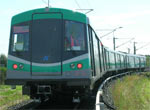  Expand Image Expand ImageThe first of the new Siemens-built trains for Kaoishung on test. |
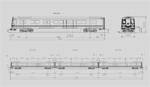 Expand Image Expand ImageDiagram of the arrangement of the motor car and train formation for Kaoishung Metro. | |
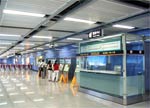 Expand Image Expand ImageAutomatic fare collection will be a feature of the Kaoishung Metro, together with automatic train operation. | |
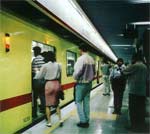 Expand Image Expand ImageMassive population growth has driven the need to provide Kaoishung with a high-capacity metro system. | |
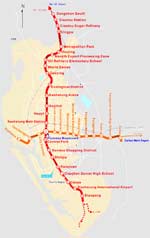 Expand Image Expand ImageA map of the first two lines – Red and Orange – showing their alignments and stations. |