Helsinki Metro Expansion, Finland


|
Finland's city of Helsinki is home to the world's most northerly metro system, which has overcome strong opposition to extend into Espoo, to the west of the city centre. The system first opened for public services in 1982, following almost three decades of planning. It is operated by Helsinki City Transport and is currently a 22.1km network with the main line split into two branch lines at Itakeskus – one running north to Mellunmaki and a second south to Vuosaari. 
Helsinki's suburbs are spread over several islands, with a greater population of 1.2 million including the Espoo and Vantaa areas. Whilst not being the most extensive of metro networks, the system attracts 50 million passenger journeys each year from the 555,000 population of the central districts. The new extension, which received official approval in September 2006, will take the system into Espoo, opening up greater journey possibilities and easier travel into the centre of the city. THE PROJECTHelsinki’s metro has been gradually extended over the past 24 years, since its official – and delayed – opening in 1982. New stations were added in 1983–84, an extension from Itakeshus to Kontula in 1986, and another to Mellunmaki in 1989. The most recent addition was the line from Itakesbus to Vuosaari in 1998. There are currently 16 stations and extensive bus networks feed the metro from surrounding areas to provide an integrated transport system. Until recently there was little support from local councils for the push into Espoo, Vantaa and Sipoo. However, September 2006 saw the end of a long running battle, with Espoo City Council approving the extension to Matinkyla by a vote of 45 to 19. Espoo – part of the greater Helsinki conurbation – lies to the west of the city centre and has a population of 230,000, making it the second biggest city in Finland. The metro extension is projected to cost €500m, and the city council has set stringent conditions for its construction, including that the Finnish State Government must pay for one third of the total bill. INFRASTRUCTUREA journey on the current metro route with its two eastern branches spends a total of 6.5km underground, 14.6km at ground level and 2.5km on bridges. The stations are a mixture of deep underground, shallow depth and ground level stations. Only those under the city centre are fully submerged, and have a dual role as air raid shelters in case of war, with space at each one for 21,000 people. The metro has been built using non-standard Finnish 1,524mm gauge track. All platforms are 135m long and fully accessible by wheelchairs. Power supply is 750V DC from a live third conductor rail, with return through the running rails. The route to the city of Espoo involves the construction of eight new stations, plus two underground water crossings between Ruoholahti (the current western terminus) and Lauttasaari and Koivusaari and Keilaniemi. Initial projections suggest that the opening date will be 2013, and not before. ROLLING STOCKTwo types of train are in service on the Helsinki Metro. The first, designated M100, was built by Stromberg of Finland, and introduced in 1977–84. A second generation of rolling stock entered service in 2001. Built by Bombardier Transportation, they are known as class M200. "The route to the city of Espoo involves the construction of eight new stations, plus two underground water crossings."
In tunnels, speed is limited to 70km/h (44mph), whilst on the open sections it is raised to 80km/h (50mph). Trains are usually six cars in length, formed of three two-car units with each vehicle 44.2m in length. SIGNALLING AND COMMUNICATIONSSignalling of the Helsinki route is maintained by four-aspect colour lights. However, this equipment is rapidly becoming life-expired, and a decision was taken in May 2006 to opt for automatic trains to replace the presently manually-driven vehicles. THE FUTUREThe future of the Helsinki Metro is potentially bright. Extensions to the Vantaa and Sipoo areas to the north of the city are still being pursued, as is a second line from Laajasalo to Pasila in the north of the city centre, and an extension to Helsinki-Vantaa Airport. Construction could start in 2020. The greatest development however is the decision by Helsinki City Council to equip the system for driverless operation. This could be in place from 2011. |
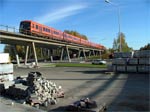  Expand Image Expand ImageBombardier built the M200 trains in 2000–2001 for the Helsinki Metro. |
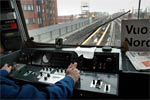 Expand Image Expand ImageHelsinki City Council is aiming to equip the metro for driverless operation by 2011. | |
 Expand Image Expand ImageThe M100 trains were built in 1977–84 and are still in daily service. | |
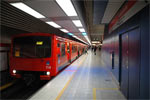 Expand Image Expand ImageThe Helsinki Metro is the most northerly system of its kind in the world. | |
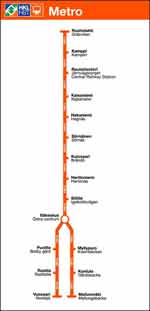 Expand Image Expand ImageThe Helsinki Metro system. |