Beijing Subway Development, China


|
Beijing's metro was approved in 1965 and had a first line of 24km, primarily motivated by military considerations. It was the first line in China and opened on 1 October 1969. A late starter with rapid transit for a major city, local provision was out of step with the capital's standing as the largest concentration in the national rail network. Branded in English language branding as Beijing Subway, the system is undergoing a spectacular expansion that included the notable stimulus of the city hosting the 2008 Olympic Games. Currently exceeded in length by the metro in Shanghai, China's largest city and premier cultural and economic force, Beijing Subway is an evolving project that will make it the longest in the country. It also seems destined to surpass the other giant systems such as London, New York, Moscow and Tokyo. 
The project With over 7.5 million in the city proper and estimates of at least 17 million present in the conurbation, Beijing is undergoing rapid growth. This includes car registrations that are increasing by over 15% each year, contrasting with road space being increased by 3% annually. In 2004 the China Academy of Railway Sciences identified that Beijing scored very low (4.7%) in terms of the percentage of urban journeys being made by rapid transit, well below the levels of Hong Kong, Moscow (both 55%) or Paris (66%). Even in Tokyo where car ownership was high compared to Beijing, the quality and coverage of public transport in the Japanese capital meant that urban rail systems enjoyed high patronage by commuters. The problems of pollution from industry and traffic were well documented prior to the Olympics, prompting extreme official measures to reduce risk levels. The apparent success of these measures plus the Games-related increase in public transport capacity appears to have strengthened the case for maintaining the commitment to rail expansion, even if has not been well received by the growing car-owning classes. Beijing city authorities also support rail expansion to cut the currently long travel-to-work times and as a stimulus for businesses to disperse from the centre to new sites in the suburbs. Funding for system expansion is thought to be 40% from municipal authority budgets approximating to $1.5bn annually, the remainder coming from commercial loans. The ¥4tr ($45.2bn) economic package released by the Chinese government also boosted the construction of the project. "Beijing has replaced a paper ticket-based system with automatic fare collection through barriers activated by magnetic strip tickets or passes."
Prior to the start of preparing for the Olympics, Beijing Subway had expanded to four lines with 1.5 million daily passenger journeys. A key link from central Beijing to Olympic venues in the north of the city opened in October 2007; the 27.6km Line 5 was the first on the network on a north-south axis. In the Olympic year itself, three new urban lines with 30 additional stations costing $3.2bn opened: on the Subway Line 10 at 25km (15.5 miles) and the 4.5km spur to the principal site, the 'Olympic Line' (during the Games reserved for competitors, officials and event ticket holders). In the longer term, it is planned that Line 10 is substantially extended to create an outer loop. The third 2008 opening was the free-standing premium-priced 28km (17.4 mile) Airport Express. On 28 September 2009, Line 4 of the subway became operational. Line 4 runs from north to south parallel to Line 5. It is 28.2km in length and connects 24 stations. Infrastructure Beijing Subway uses a 1,435mm gauge with 750V dc third rail electrification with surface and underground running. The time span of system development is reflected in the styles, layouts and many types of rolling stock. Within the stations, the Subway authority believes that there is inadequate provision for commercial activity and expects to provide more opportunities for small enterprises such as convenience stores. To reach the international airport to the north-east of the city centre, a different rail format was adopted for the new line that terminates at the Dongzhimen Subway interchange. With more widely spaced stops and a 110km/h maximum in contrast to the Subway's 80km/h maximum, there is a journey time of around 16 minutes. Rolling stock Unlike the Shanghai Metro that sourced rolling stock from overseas suppliers such as Bombardier, Siemens and Alstom, Beijing Subway has favoured domestic producers. There is a wide range of classes, some earlier batches having been subject to severe reliability and build quality problems. With the introduction of the newest lines, train capacities have increased to over 1,400, up 340 over previous formations. Signalling and communications "Beijing Subway should have 19 lines totalling 561km (349 miles) in operation by 2020."
With education and instruction measures in place to smooth the transition, Beijing has replaced a paper ticket-based system with automatic fare collection through barriers activated by magnetic strip tickets or passes. Chinese characters and announcements are supplemented by information in English. By August 2008 it was claimed that all 123 stations had at least one access point available to wheelchair users. The future The chairman of the Beijing metro construction administration corporation announced in August 2008 that two to four new Subway lines would be commenced by the end of the year, with work set to continue on the nine already under construction. Work on the Yizhuang Line (Line L2), which will extend 23km (14.3 miles) from the southern terminus of Line 5, began on 8 December 2007, with trial services due in 2010. Beijing Subway should have 19 lines totalling 561km (349 miles) in operation by 2015, with an expected 9 million passenger journeys per day. |
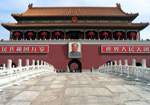  Expand Image Expand ImageChina and its capital have transformed their identity and economic standing radically in recent decades. |
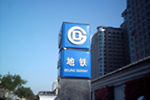 Expand Image Expand ImageA relative latecomer to rapid transit, Beijing's Subway is in part now seen as a way to handle city expansion and provide more reliable journey times. | |
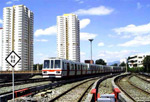 Expand Image Expand ImageBeijing Subway has a large variety of rolling stock in operation on the various lines. | |
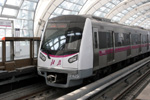 Expand Image Expand ImageOpened in 2007, Line 5 is representative of the modern expansion of the system. | |
 Expand Image Expand ImagePaper-based ticketing has given way to revenue control by barriers activated by cards and magnetic ticket strips. | |
 Expand Image Expand ImageStimulated by the 2008 Olympic Games, Beijing looks set to become the world's biggest metro system. |