Al Mashaaer Al Mugaddassah Metro Project, Saudi Arabia


|
The Al Mashaaer Al Mugaddassah Metro Line project in Makkah (Mecca) saw a 18.1km line constructed to connect the holy cities of Mecca, Arafat, Muzdalifa and Mina. A contract worth $1.8bn for the project was awarded by the Saudi Arabian government in February 2009 to a consortium of companies led by China Railway Construction (CRCC). CRCC carried out construction of the infrastructure and will integrated various systems. 
The Mecca monorail project has been one of many undertaken by Saudi Arabia to expand its railway network to meet the transportation needs of its growing population of 25 million and improve an antiquated logistics infrastructure. The line provides transport for about 3.5 million people who arrive at Mecca annually to perform Hajj. The number is expected to increase to five million in future. The project Construction of the monorail project has helped to solve the problem of heavy traffic congestion in the holy cities during the Hajj period and meet the transportation needs of the local people . Masterplans drawn up by MonoMetro show that five monorails need to be constructed to handle the flow of pilgrims to the holy cities. "The Makkah monorail project has been one of many undertaken by Saudi Arabia to expand its railway network."
Based on the need to transport pilgrims from Mina to Arafat a four-line parallel loop network was developed. The line can transport about 500,000 pilgrims in six to eight hours. It has also allowed authorities to reduce the number of buses needed to transport pilgrims from 70,000 to 25,000. The first phase of the project includes the four-line loop with a network of pick-up and drop-off stations between Mina and Arafat. The first of the five new metro lines started operating with Automatic Train Protection at 35% capacity by November 2010. By mid-2011, the line will run without a driver but with an attendant on board. The metro will reach full capacity to carry 72,000 passengers in each direction per hour by 2011's Hajj. About 8,000 skilled and unskilled workers, along with 5,000 engineers, were engaged in the project. The line services Mina, Arafat and Muzdafila, each of which have three substations each. The four-line parallel loop network splits into single tracks covering all the encampment zones in Mina. Mina is the last station on the metro line and is located towards the west of the Jamarat Bridge. The metro line will be linked to all the four floors of the bridge with elevators. The four-line parallel route moves south towards Arafat before reaching a main station next to the Arafat Mosque and splitting again into a single-line network to carry pilgrims into Arafat. The lines come together again and move towards Muzdelefa, where pilgrims can spend ceremonial time before returning to Mina. The line runs on a viaduct with the depot located at the end of the trail that is behind the first station in Arafat. A turnaround loop is planned between the last station and the depot. Infrastructure The trains of the monorail can operate at an elevation ranging from 8m to 10m so that they do not obstruct the movement of vehicles and pedestrians on the ground. The trains will comprise 12 carriages, each 20m long and 3m wide. The monorail runs on a powerful superstructure made of steel railroads supported by solid concrete pillars made of prefabricated steel masts and beams. "The metro will reach full capacity to carry 72,000 passengers in each direction per hour by 2011's Hajj."
The design of the superstructure is auto-responsive to the forces of acceleration and emergency braking, with columns and specialised beamways that act as a kinetic energy absorbing/redistribution network, as well as the modular elevated station kit. Controlled access to the monorail prevents accidents such as the tragedy at Mina in 2006, when more than 350 people died in a stampede. Trains on four elevated tracks will transport 20,000 pilgrims per hour in an orderly manner. The project will also include the construction of multi-storey parking facilities at the entrance of Mecca to help pilgrims park their cars before boarding the trains. Rolling stock The rolling stock for the monorail includes five-car sets running together as ten-car sets supplied by MonoMetro, UK. Each five-car set is entirely interconnected and air-conditioned with separate areas for men and women. Each five-car set has a central emergency escape car with inflatable chutes to enable pilgrims to escape in case of an emergency. As the tracks form a closed loop each train set circulates several times between Mina and Arafat. The rolling stock is stabled throughout the year for cleaning and maintenance at the depot in Arafat. The technology on which the monorail is based is steel wheels running on steel rails in a vector bifurcation bogie capture configuration. The wheel-rail interface geometry for the monorail was developed by MonoMetro with SKF, the Swedish bearings manufacturer. ESG, the mechanical engineering arm of English Welsh and Scottish Railways, will develop the vector bifurcation bogie sets. Knorr-Bremse was awarded a $55m contract to provide braking systems for trains and station platform screen doors for nine stations of the metro line. The contract to supply 17 Type-A 12-car metro train sets was awarded to Changchun Railway Vehicles in April 2009. "Each five-car set is entirely interconnected and air-conditioned with separate areas for men and women."
Signalling and communications CRCC awarded a $144m contract to Thales in June 2009 to supply, integrate and deploy its driverless train control and telecommunication systems for the project. Thales designed, integrated, installed, tested and commissioned the systems. It also installed the SelTrac Communications-Based Train Control (CBTC) system in the metro project. Thales will also supply its fully integrated communications solution including an operation control centre, CCTV, SCADA and an automatic address and information system. Contracts Westinghouse Platform Screen Doors provided the PSDs for the project, Siemens supplied power and Lloyds Register acted as the safety assessor. Systra carried out the civil work and WS Atkins was in charge of electrical and mechanical systems, and project management. Brecknell Willis, a UK supplier of power rails and current collection shoes for railways, provided a lightweight aluminium power rail with stainless steel contact surface. It also supplied 1,500v DC and a current draw of 3,000A. TPI Composites, a US manufacturer of high-strength low-weight composite lightweight vehicles, manufactured the cars. UK firm Intelligent Engineering provided patented elastomeric bonding technology for the butterfly masts, side arms and the consecutive beam junction assembly with viscous damping. The technology enables cyclical expansion and contraction to sustain heat in the region. It also provides high resistance to emergency braking force. Buro Happold was responsible for developing the structural engineering of the MonoMetro superstructure. The future Studies are being carried out to ascertain the extension of the monorail to a station close to the Grand Mosque in Mecca and linking it with Jeddah airport and the Haramain Railway that connects the two holy cities of Mecca and Madinah. Similar projects are planned for the city of Madinah in the future. |
  Expand Image Expand ImageThe Al Mashaaer Al Mugaddassah Metro Line project will connect the holy cities of Mecca, Arafat, Muzdalifa and Mina. |
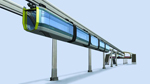 Expand Image Expand ImageThe monorail project consists of five-car train sets with separate areas for men and women. | |
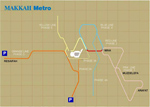 Expand Image Expand ImageThe Mecca metro project is under construction in several phases, and should be complete by 2011's Hajj pilgrimage. | |
 Expand Image Expand ImageThe first phase of the project includes the four-line loop with a network of pick-up and drop-off stations between Mina and Arafat. | |
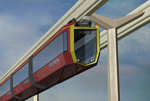 Expand Image Expand ImageThe five-car sets for the monorail are being supplied by UK firm MonoMetro. | |
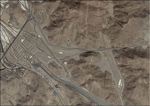 Expand Image Expand ImageThe Mecca project is aimed at easing congestion in times of pilgrimage as well as providing extra transport for Saudi residents. | |
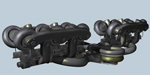 Expand Image Expand ImageThe vector bifurcation bogie is articulated at the vertex between either side with steel wheels running on steel rails. |