Top Ten Record-Breaking Stations
More than just a platform and tracks, rail stations are often the centrepiece of a nation's transport infrastructure. We look at ten of the world's record breakers.Date: 08 Feb 2010


|
Grand Central Terminal, New York, US According to some sources, New York's Grand Central Terminal is the world's largest station in terms of platform capacity. It houses a staggering 44 platforms and 67 tracks over two levels below ground, which will be increased to a total of 75 tracks and 48 platforms when Long Island Rail Road's new station opens below the existing levels in 2013. 
Covering an area of 48 acres, the station serves commuters travelling in New York State on the Metro-North Railroad to Westchester, Putnam and Dutchess counties, as well as Fairfield and New Haven counties in Connecticut. The station replaced the original Grand Central Station, which was demolished in phases between 1903 and 1913. Today's structure was designed by the architectural firms Reed and Stem and Warren and Wetmore. "New York's Grand Central Terminal houses a staggering 44 platforms and 67 tracks."
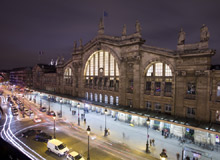
Gare du Nord, Paris, France Gare Du Nord is reportedly Europe's busiest railway station in terms of total passenger numbers and the world's second-largest station in terms of passenger capacity. The station predominantly operates trains to Northern France but also offers high-speed connections to various international destinations such as the UK, Belgium, Germany and Holland. At the moment services are operated at the station by SNCF, Eurostar and Thalys. Gare Du Nord was constructed between 1861 and 1864 and designed by the French architect Jacques Hittorff. Shinjuku Station, Tokyo, Japan Shinjuku is often referred to as the world's busiest station in terms of daily passenger throughput. The station acts as a hub to connect rail traffic between central Tokyo and its western suburbs through a range of inter-city rail, commuter rail and metro lines. According to some sources, the station recorded an average of 3.64 million people per day in 2007. Shinjuku Station was opened in 1885 and is now home to a range of rail operators including East Japan Railway Company (JR East), Odakyu, Keio, Tokyo Metro and Toei. JR East section of the station alone has seven ground-level island platforms and 14 tracks, and handles an average of 1.5 million passengers per day. Clapham Junction, London, UK Clapham Junction is reportedly Europe's busiest station in terms of through daily rail traffic. "Japan's Nagoya Station is the world's largest station in terms of floor area, at an astonishing 446,000m²."
The station is situated in the south west London borough of Wandsworth and as a result many routes from London's two busiest stations – Waterloo and Victoria – pass through its platforms. It is estimated that each day about 2,000 trains pass through Clapham Junction, while during peak times 180 trains reportedly pass through the station each hour, 117 of which stop. All services from Waterloo are operated by South West Trains while many from Victoria are catered to by Southern and Gatwick Express. Interchanges account for roughly 40% of all activities at the station. Chhatrapati Shivaji Terminus, Mumbai, India Mumbai's Chhatrapati Shivaji Terminus is one of India's most historic and busiest stations. The station serves Central Railway trains – which covers much of the state of Maharashtra and parts of North-Eastern Karntaka and Southern Madhya Prades, making it the largest out of 16 of Indian Railways zones – alongside the Mumbai suburban railway. The station was designed by Frederick William Stevens in 1887–88 and is renowned for its gothic style, which bears more than a passing resemblance to London's St Pancras station. The station also featured prominently in the 2008 Academy Award winning movie Slumdog Millionaire. Nagoya Station, Nagoya, Japan Japan's Nagoya Station is the world's largest station in terms of floor area, which according to some sources stands at an astonishing 446,000m². It is the headquarters of the Central Japan Railway Company (JR Central), which has two towers that run atop of the station. The station was completed in December 1999 and reportedly recorded an average of 1,140,000 passengers per day in 2006, making it at the time Japan's sixth-busiest station. Zurich Hauptbahnhof, Zurich, Switzerland Zurich Hauptbahnhof in Switzerland is often referred to as Europe's busiest station in terms of daily rail traffic. Residing in the heart of the Swiss capital, the station accommodates trains from all over Switzerland as well as from neighbouring European countries such as Italy, France and Germany. The station has three floors, one of which is largely dedicated to international trains, another which is for the exclusive use of SZU S-Bahn trains and the final one caters for regional operations. According to some sources, Zurich HB is served by more than 2,700 trains daily. Leipzig Hauptbahnhof, Saxony, Germany Leipzig Hauptbahnhof (often translated as Leipzig Central Station) is reportedly Europe's largest station according to floor area. The station opened in 1915 as an important junction between north-to-south and west-to-east German railway lines. Today it has 24 platforms which, according to some sources, cater to an average of 150,000 passengers per day and a total of 54 million passengers per year. "New York's Penn Station serves 600,000 passengers a day at a rate of up to 1,000 every 90 seconds."
The station's most distinguishing feature is its multi-level concourse with towering stone arches and a 293m-long façade. During World War II, bombings led to the roof of the concourse collapsing but it was restored to its original appearance in the 1950s. Penn Station, New York, US New York's Penn Station is often referred to as North America's busiest station. According to some sources, the station serves 600,000 passengers a day at a rate of up to 1,000 every 90 seconds. The station is located in the underground levels of Pennsylvania Plaza in Midtown Manhattan. It is owned by Amtrak and is home to the Northeast Corridor, a vital passenger rail line extending between New York, Washington and Boston. It also serves commuters through the Long Island Rail Road and New Jersey Transit as well as six New York Subway routes. Tanggula (Dangla) Station, Amdo County, China Tanggula Station is the highest in the world. It resides at an astonishing 5,068m above sea level and caters to the Qingzang railway – a high-altitude network that connects Xining, Qinghai Province to Lhasa in the Tibet Autonomous Region of China. According to sources, the unstaffed station has a platform stretching more than 1.25km in length and has three rail tracks. The station offers stunning views of the Taggula Mountain, making it a sightseeing hotspot for tourists. |
  Expand Image New York's Grand Central Terminal is the world's largest station in terms of platform capacity. |
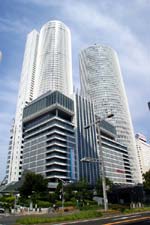 Expand Image Japan's Nagoya Station is the world's largest station in terms of floor area. | |
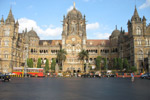 Expand Image Mumbai's Chhatrapati Shivaji Terminus is one of India's most historic and busiest stations. | |
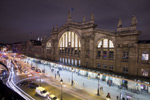 Expand Image Gare du Nord in Paris is reportedly Europe's busiest station in terms of passenger numbers. |

Related links
New York Rail: Rising from the Ashes