UK Rail Planning – the Next 30 Years
A new White Paper has assessed and planned the future of Britain's railway infrastructure. Howard Johnston looks at forthcoming projects and improvements, and how they are expected to increase sustainability.Date: 12 Dec 2007


|
Claimed by the UK Government as 'the most positive statement about the growth and development of rail for over 50 years', Ruth Kelly, Secretary of State for Transport, presented 'Delivering a Sustainable Railway' to Parliament on 24 July 2007. Covering the potential challenges for the network up to 30 years ahead and announcing a £15bn spend up to 2014, the White Paper identifies three long-term agendas: increasing railway capacity, delivering a quality service for passengers and fulfilling rail's environmental potential. 
In the seven years from 2007, the UK rail system is anticipated to carry at least 180 million more passengers, with capacity increased to handle over 20% growth. "In the seven years from 2007, the UK rail system is anticipated to carry at least 180 million more passengers."
Official emphasis remains on a network that is safer and more reliable, expecting a punctuality improvement from 88% to 92.6%, with delays of 30 minutes or more reduced by 25%. General and trade-related media responses to the document focused on commitments made for specific locations, direct implications for rail users and the proportional shift in the burden of funding the proposals. LOCATION, LOCATION, LOCATION Three specific locations dominate the spending projections. With a £5.5bn budget, the plan to improve and expand the Thameslink operation by 2015 is consistent with population density, economic significance and over half of all rail journeys starting or finishing in London. Structured to make extra capacity available in time for the London Olympics, the two-stage development will enable 12-coach trains to operate the current Bedford-Brighton route by 2011. With greatly increased frequency, the addition of Peterborough and King's Lynn/Cambridge line services north of the Thames, and many more destinations to the south, the project also includes major redevelopment for Blackfriars and London Bridge stations. The second largest allocation is the £425m to remove the operational bottleneck represented by the Reading area, where line capacity at either side greatly exceeds that of the station. At the divergence of Great Western routes, a terminus of the commuter line to London Waterloo and on the north and Midlands route to the south coast, Reading station is the second busiest outside London. It also handles substantial freight traffic, mainly aggregates from Somerset quarries to London and containers for Southampton. Work should start in 2009 on longer platforms, five new platforms, improved track layout and re-signalling. "An additional $150m is earmarked to assist the modernisation of 150 other stations."
Birmingham New Street, operating at twice its design capacity and with 'significant passenger congestion and an unattractive environment', is the third designated location for improvement. The funding only relates to the first development phase of a project that could require £500m. Although in the short term conditions will be improved by a much-enlarged concourse and better access, the basic site constraints for tracks and platforms seem likely to remain. An additional £150m is earmarked to assist the modernisation of 150 other stations. These are likely to be characterised by extra works in connection with the existing £370m 'Railways for All' accessibility programme; those identified as high priority for particular routes and those where the station forms part of wider community improvement programmes. A clear candidate is Cardiff, where a one-fifth increase in peak demand is forecast by 2014. Peterborough, a commuter, regional and long-distance interchange, is constrained by limited platform capacity and conflicting movements. A different problem is apparent at Bristol Temple Meads, where passenger handling before reaching the platforms is contained in a small, awkwardly configured concourse area. ROLLING STOCK – NEW BUILD EXTENDED TO 1,300 Extending a previous commitment for 1,000 extra carriages, the anticipated new build is 1,300, around 70% relating to the London commuter network. Most of the rest is for other overstretched urban services such as Manchester, Cardiff, Leeds and Birmingham. With cascading and refurbishment envisaged, bottom-of-the-pile Pacer and Sprinter classes are designated candidates for earliest fleet withdrawals. The make-up of the new build into units is not yet specified. "The anticipated new build is 1,300 extra carriages, around 70% relating to the London commuter network."
Although not part of the funding announcements, reference is made to the 'Intercity Express train' which is in the early stages of the procurement process. Identified with the environmental agenda with diesel, electric and hybrid versions, this high-speed train replacement for full service by 2015 should be introduced on the Great Western and Great Northern main lines. Network Rail is charged with ensuring that routes are ready to accommodate the new trains. STRATEGIC FREIGHT NETWORK In spite of rejecting dedicated freight lines like the Dutch Betuweroute, there is a long-term aim for the network to handle twice the current levels. The White Paper promotes the creation of a Strategic Freight Network, with measures including greater availability of paths, increased gauge clearances, increased load capability and overall greater stability in the operational framework for potential clients. A £200m investment is for freight enhancements between 2009 and 2014, by which time a 30% growth is expected. THE USER PAYS A greater share of the cost of improving and operating the network will be placed upon rail users. Increased numbers paying higher fares will underpin the proposals, with funding from general taxation proportionally reduced. By 2014 it is expected that rail users will meet 75% of costs, with the balance derived from general taxation. "A $200m investment is for freight enhancements between 2009 and 2014, by which time a 30% growth is expected."
The 'user pays' approach is possibly the most contentious aspect of the Government's vision for the sustainable railway. Distancing the rail network from being perceived as part of the country's essential infrastructure is another aspect where the British way differs from that of the country's main economic competitors. Simplification of a ticket structure which has fragmented and become confusing under franchised operations is promised, moving to only four types of tickets. A greater use of electronic ticket sales is envisaged. PROJECTS POSTPONED AND REJECTED Implications for the UK rail industry are as much to do with the rejections and omissions in 'Delivering a Sustainable Railway' as the inclusions. Relative to mainstream western European practice, the UK stands apart in its limited mainline electrification. Identified at 39%, a significant amount of this is in the former Southern Region third-rail dc network. Few intensively used routes comparable to Glasgow-Edinburgh, London-Bristol/Cardiff, London-Sheffield or York-Liverpool remain unwired across the Channel, similarly with 'missing links' such as Manchester-Preston-Blackpool or the Felixstowe/Harwich freight artery between Haughley Junction and Peterborough. With opportunity cost cited as the main counter-argument for electrification (like a Maglev operation, also sidelined as an 'all or nothing project'), other reasons include that hydrogen fuel cell development may yield usable technology and that electrification may hazard the working of signalling systems, views that seem not to have impeded electrification in Germany, France or Japan. "By 2014 it is expected that rail users will meet 75% of costs, with the balance derived from general taxation."
A new north-south high-speed line, like the High Speed 2 line promoted by the Greengauge 21 group, is another project put in the 'all or nothing' category which does not reflect today's priorities. Any eventual development of such a line would be better delivered along existing or abandoned alignments like the Great Central, according to the White Paper. Closures are not part of the plan, although the possibility is foreshadowed of lifting protection of former rail alignments in favour of other reuses. Crossrail, a long-standing £16bn project for a new east-west route through central London, is identified in the White Paper as having a value comparable with Thameslink. However, the project is postponed until at least 2014, possibly as it would cost three times the Thameslink works. On rail-airport links, the White Paper adopts the 'beneficiary pays' premise. In an echo of the electrification argument, the UK again differs from comparably developed countries. Birmingham and Gatwick are rare examples of major UK airports served by through routes (as opposed to spur lines to the city centre like Heathrow or Manchester). No equivalent airport integration with the national network as at Paris Charles de Gaulle, Amsterdam Schiphol, Zürich or the future Berlin Brandenburg is projected. FAITH IN THE FUTURE 'Delivering a Sustainable Railway' has appeared during a prolonged resurgence by rail, notably in respect of passenger traffic. The claim for it as being 'the most positive statement about the growth and development of rail for over 50 years' lies not so much in any one, or even the aggregate, of its component projects. There are no bold commitments to the equivalent of an LGV or Shinkansen network; for all the environmental rationale, nor to network electrification; no emblematic technology like an ICE or an urban counterpart to the S-Bahn for Britain's larger cities. In reality, much of the content addresses shortcomings that have been allowed to accumulate for decades. Apparently keen to keep the general taxpayer at greater arm's length from funding rail as part of the country's vital infrastructure, the White Paper of July 2007 is nevertheless a welcome and strong indication of a government showing faith in the future of rail. |
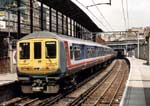  Expand Image Seen shortly after opening, Thameslink is to be extended and capacity increased. Farringdon station is scheduled to be on the delayed east-west Crossrail line. |
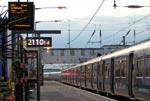 Expand Image The largest White Paper project, Thameslink, will incorporate Peterborough (pictured) and Cambridge services. | |
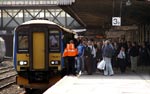 Expand Image 'Capacity has not kept pace with record demand' – Many passengers boarding this two-car unit at Nottingham will stand for at least part of their trip towards Lincoln. | |
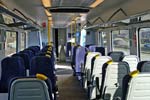 Expand Image 'An additional 1,300 new carriages' – More units are expected like the Class 350s that have already improved accommodation standards on the West Coast Main Line. | |
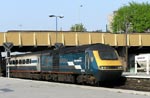 Expand Image The UK is set to remain apart from mainstream European practice. Electrification of busy routes like the Midland mainline is not considered a good use of resources. | |
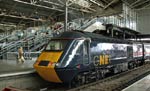 Expand Image 'Flagship Intercity Express trains will enter service from 2015', replacing HSTs like this one at Leeds, a location cited for its rapid growth in demand. | |
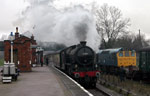 Expand Image Seen here on a preserved section, the former Great Central route is cited as an example of re-using abandoned alignments in preference to entirely new builds. | |
 Expand Image Fare increases and increased numbers mean that passengers will fund a greater proportion of costs for improving and operating the UK rail network. | |
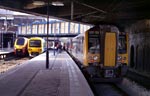 Expand Image Relieving overcrowding and improving the environment for passengers at Birmingham New Street is a high priority. | |
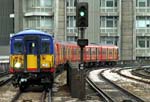 Expand Image The Government recognises that London's busiest commuter routes may need 'additional interventions…radical action beyond those currently considered'. | |
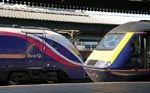 Expand Image Other than Thameslink, the largest single designated project is work to unblock the operational bottleneck at Reading. | |
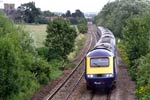 Expand Image With aggregate traffic, long-distance and local passenger trains, the mainly rural 'Berks and Hants' is one of many lines converging on the Reading bottleneck. | |
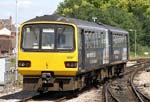 Expand Image A concept described as 'regional go-anywhere trains' should see the end of the bus-based Pacer fleet. | |
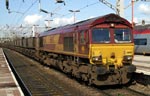 Expand Image Creating Strategic Freight Network with higher capacity and availability is to be encouraged with an allocation of $200m. | |
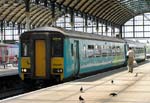 Expand Image Low-density rural routes like Hull-Scarborough seem to have a more secure future under the White Paper. |