New requirements have been introduced for the braking systems of freight wagons
Yu.Ya. Vodyannikov, Candidate of Technical Sciences, Senior Researcher,
M.I. Yalansky, K.L. Zhikhartsev, State Enterprise "Ukrainian Scientific Research Institute of Carriage Engineering"
According to the new requirements of NB ZHT CV 01-98 "Freight railway wagons. Safety standards" their implementation is carried out by mandatory inclusion in regulatory documents, technical specifications (technical requirements) and technical specifications for wagons.
To date, none of these requirements have been reflected in the regulatory documents in accordance with which freight wagons are designed and manufactured. This causes significant difficulties both in the design of freight wagons and in conducting certification tests. This is especially true for the braking systems of freight cars.
The braking systems of newly designed freight wagons must, of course, meet all the requirements of NB ZHT CV 01-98. At the same time, they are designed in accordance with the "Standards for calculation and design ...", and their characteristics must meet the requirements of CV-CL-945 "Instructions for the repair of braking equipment of wagons" and CT-CV-CL-VNIIZHT/277 "Instructions for the operation of brakes of rolling stock of railways."
Thus, the time to increase the force of pressing the brake pads to the maximum value during emergency braking should be no more than 15 seconds. It is determined by the time the pressure in the brake cylinder increases to 95% of the maximum value from the moment of exposure to the brake control device.
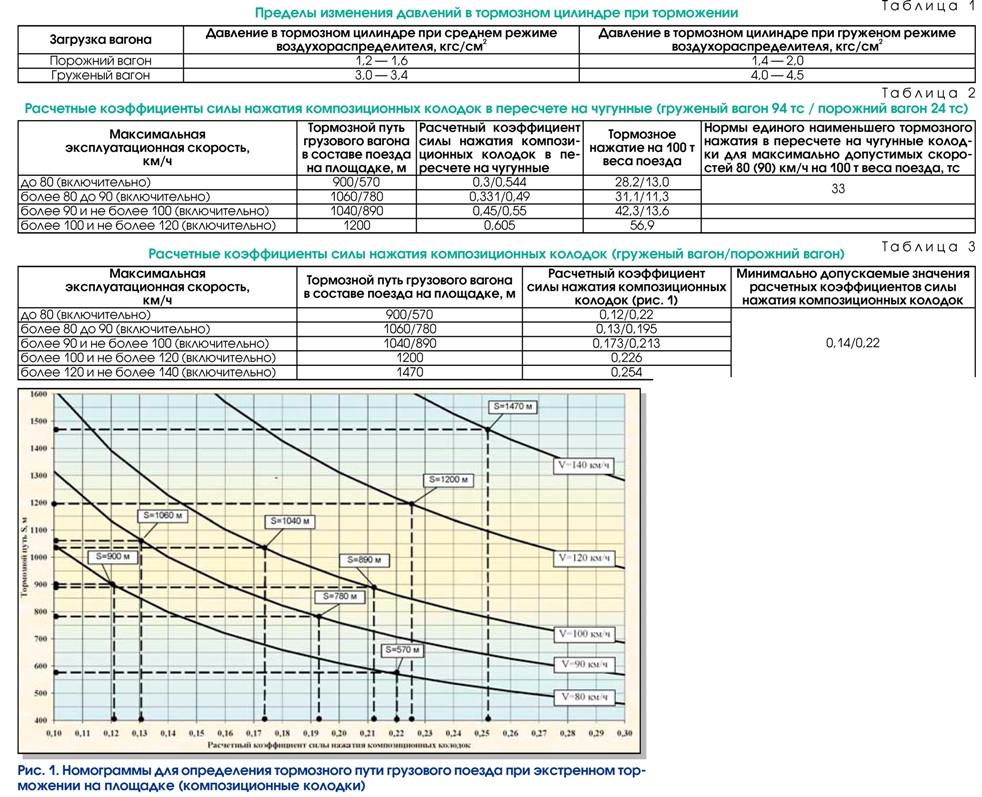
At the same time, the requirements set the permissible limits for pressure changes in the brake cylinder during braking (Table 1). The minimum values are used to assess braking performance, the maximum values are used to check the absence of a skid situation.
During emergency braking, maximum pressures are usually applied in the brake cylinders. Their values are within the limits indicated in the table. 1. At the same time, the lack of specific values in the NB ZHT CV 01-98 of the maximum pressure in the brake cylinder, taking into account the modes of the air distributor and loading of the car, does not allow us to unambiguously verify compliance with paragraph 12 of the new requirements.
It should also be noted that for the 483M air distributor used for freight wagons, the filling time of the brake cylinder with full service braking up to 3.5 kgf/cm2 is 7-15 seconds.
Analysis of the table. 2 shows that the set braking distance limits do not correspond to the required braking performance according to the calculated coefficient of force of pressing the pads on the wheels (for a loaded wagon at least 0.14, empty — 0.22). Such a discrepancy occurs for a loaded wagon at speeds of 80 and 90 km/h, for an empty wagon of 90 and 100 km/h, respectively (Table 3).
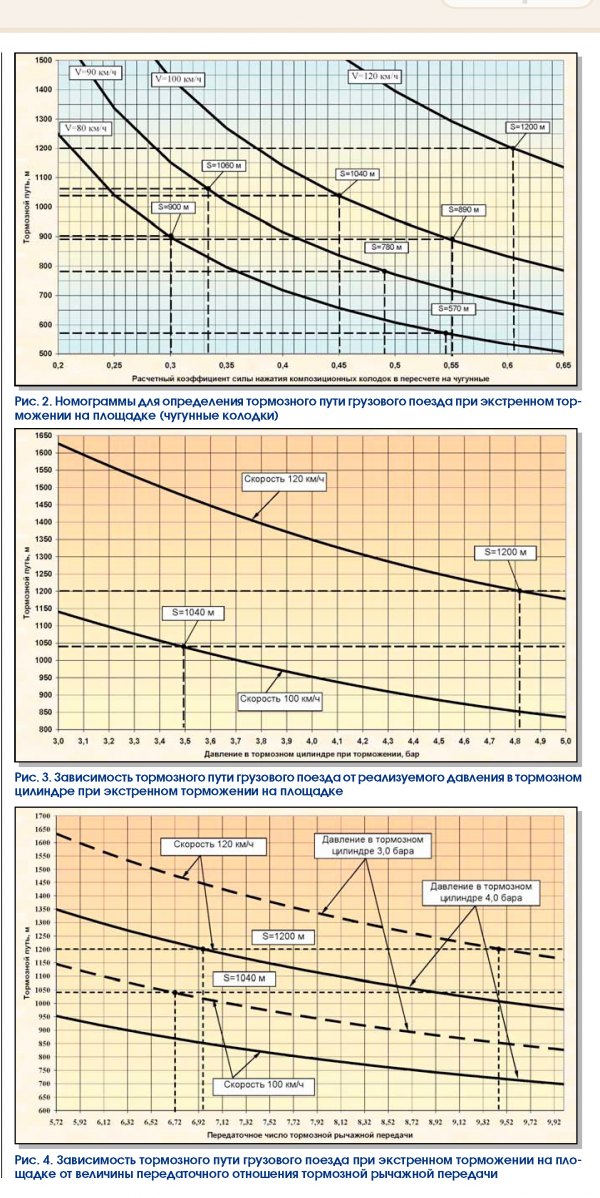
The recalculation of the calculated coefficient of the compressive force of composite pads on cast-iron ones indicates that the set braking distance limits (see Table. 2) do not comply with the standards of the single smallest brake pressure per 100 tons of train weight (Fig. 1, 2).
Special difficulties arise when calculating the braking efficiency of freight wagons, taking into account the new requirements of the NBT CV 01-98. Most mainline freight wagons are designed for a maximum structural speed of 120 km/h.
The stopping distance of a car in terms of a train should not exceed 1040 and 1200 m at speeds of 100 and 120 km/h, respectively. Computational studies of braking efficiency using the example of a gondola car with a brake lever gear ratio with composite pads of 5.72 show that these braking distances can be obtained at a pressure in the brake cylinder for speeds of 100 and 120 km/h of 3.49 and 4.81 kgf/cm2, respectively (Fig. 3). These values exceed the pressure (3.0 and 4.0 kgf/cm2), taken to evaluate braking performance.
Obviously, to meet the requirements at minimum brake cylinder pressures of 3.0 and 4.0 kgf/cm2, it is necessary to increase the gear ratio of the brake lever gear. The performed multivariate calculation studies showed that at a pressure in the brake cylinder of 3.0 kgf/cm2 for a speed of 100 km/h, the gear ratio is 6.72, for a speed of 120 km/h —9.47, at a pressure of 4.0 kgf/cm2 for a speed of 120 km/h — 6.97 (Fig. 4).
Checking for the absence of a slip showed that the condition for the absence of a slip is not fulfilled for the obtained gear ratios (Table 4).
The maximum value of the average operating power per composite shoe at a speed of 120 km/h and a stopping distance of 1200 m is 90.7 kW. This is 29.5% more than the maximum permissible value of 70 kW, for a speed of 140 km/h exceeds the operating capacity by 68% (117.5 kW).
The results of train tests of a gondola car on the platform in the loaded state by the "throwing" method in the speed range at the beginning of braking (40 — 120 km/h) at pressures in the brake cylinder 3.0 kgf/cm2 (average air distributor mode), 3.8 kgf/cm2 and 4.0 kgf/cm2 (loaded air distributor modes) are shown in Fig. 5, 6 and 7. At a speed of 100 km/h, the braking tracks of a freight train meet the requirements when the air distributor is switched on to loaded mode. For a speed of 120 km/h, the braking distances of a freight train, when the air distributor is switched on, exceed the maximum permissible values of 1200 m.
Diagrams based on the results of train braking tests of a semi-trailer in a loaded state indicate that a braking distance of 1,470 m for a speed of 140 km/h cannot be obtained within the permissible pressure change in the brake cylinder. For a speed of 120 km/h, the pressure should be at least 4.4 kgf/cm2, for a speed of 100 km/h — at least 3.1 kgf/cm2 (Fig. 8).
Based on the analysis of the new requirements of NB ZHT CV 01-98 for freight wagon braking systems, the following has been established: > the absence of a numerical value for the maximum pressure in the brake cylinder during emergency braking (clause 12 (1)) does not allow us to unambiguously determine the time of pressure build-up in the brake cylinder to 95% of the maximum value from the moment of impact on the brake control device during certification tests;
- the maximum permissible values of the braking distances indicated in Table 2 do not correspond to the standard value of the calculated coefficient of compressive force of the composite pads (see Table. 3), as well as the single smallest brake pressure in terms of cast iron pads for maximum permissible speeds of 80 (90) km/h per 100 tons of train weight (see Table. 2);
- the calculation of the freight car brake, as well as train braking tests, showed that for freight cars with one-way pressing it is impossible to implement the requirements for speeds of 120 and 140 km/h, since:
- the condition of the absence of a skid for an empty car is not fulfilled in the average mode of the air distributor (guaranteed jamming of the wheelsets during braking);
- the average power per brake composite pad during emergency braking exceeds the maximum permissible value of 70 kW for speeds of 120 km/ h by 29.5%, for speeds of 140 km/ h — by 58%.
From all of the above, the following conclusions can be drawn:
- the braking distances shown in Table 2 for speeds of 80, 90 and 100 km/h do not meet the minimum requirements for braking performance;
- requirements for speeds of 120 and 140 km/h (see Table. 2) can be implemented for freight wagons only with double-sided pressing of composite pads;
- for the operation of loaded freight trains with speeds from 90 to 100 km/h inclusive, the air distributor must be set to "loaded" mode.







 09.11.2022, 21:02


 Похожие темы


 Почта
Почта